Introduction
The Curaleaf Spanish language cannabis program expands language access by offering translated retail, bilingual education, and in store Spanish kiosks. It lowers barriers for patients with limited English proficiency and brings culturally fluent care through native Spanish speaking staff and targeted materials. Federal guidance requires language assistance to ensure equitable care, which supports these program goals federal limited English proficiency guidance.
About 68 million Latinos live in the United States, so Spanish patient education can reach large communities and improve public health outcomes key facts about U.S. Latinos. One Florida patient said, “Me sentí escuchada y comprendida,” a comment made after speaking with a Spanish speaking budtender and translated as “I felt heard and understood.” Thesis: The Curaleaf Spanish language cannabis program improves access and safety for Spanish speaking patients by combining translated resources, bilingual staff, and culturally fluent education.
What is the Curaleaf Spanish-language cannabis program?
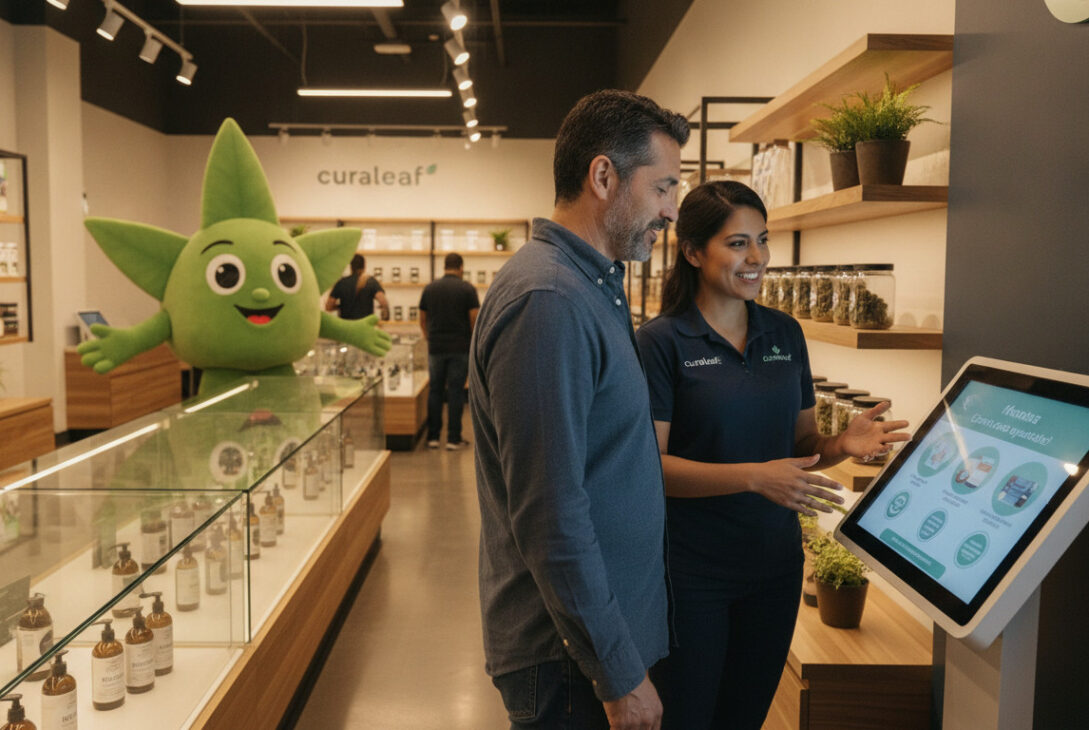
Curaleaf Spanish-language cannabis program delivers an end to end Spanish experience across retail, e commerce and media. It includes in store Spanish kiosks, a translated curaleaf.com experience, a SWEED Spanish storefront, bilingual education materials and Spanish language paid media. Piloted in Florida; national rollout planned, and eligibility follows state medical or adult use regulations so patients should confirm local eligibility and bring required identification.
For more information see Curaleaf Spanish program details. The initiative was launched in partnership with Sweed for retail and e commerce support Sweed press announcement. Meta description: End to end Spanish cannabis patient experience piloted in Florida; national rollout planned. Learn eligibility and program features.
Benefits of the Curaleaf Spanish language cannabis program
The Curaleaf Spanish language cannabis program improves access and cultural relevance for Spanish speaking patients. The program reduces communication barriers and builds trust by pairing bilingual tools with local language review and culturally aware materials.
- Accessibility
The program enables Spanish speakers to read product details, complete purchases and navigate a translated curaleaf.com and in store kiosks in Spanish. It lowers obstacles for people with limited English proficiency (LEP) and helps ensure accurate dosing and consent. See Census language use estimates for Spanish spoken at home for context ACS table on language use.
- Community connection
Native Spanish speakers vet tone and idiom so communications feel culturally fluent rather than literal and impersonal. Curaleaf’s hiring of bilingual budtenders strengthens rapport, improves patient counseling and supports trust during in person visits. Local events and paid Spanish media further deepen neighborhood ties.
- Education and safety
The program offers Spanish patient education through bilingual dosing guides, a Bienvenido al Cannabis 101 piece and in store materials that explain risks and safe use. Bilingual budtenders reinforce learning at point of sale and reduce confusion about product labels and interactions.
- Financial support
A 60 percent new patient discount for the first three visits reduces cost barriers and encourages initial engagement, especially in states with large Latino populations. National demographic context is available from Pew Research Key facts about U.S. Latinos.
- Scalability
Because the program was designed end to end, including a SWEED Spanish storefront and locked glossaries for brand names, it can be adapted to other languages and markets. Measuring outcomes and local feedback will be essential for faithful scale.
KPI callout: track percent Spanish language purchases, Spanish patient satisfaction score, discount uptake rate, repeat visit rate and percent of visits with bilingual budtenders on duty.

How to Access the Curaleaf Spanish-language cannabis program
Use these steps to register, save on visits, and learn safely in Spanish. The program pairs translated pages, a SWEED Spanish storefront, and in store kiosks for a seamless experience.
- Find a participating dispensary using the program pages or your state dispensary locator.
- Register online through the portal and claim the 60 percent discount for your first three visits.
- Use in store Spanish kiosks to access bilingual education, dosing guides and product details.
- Speak with native Spanish speaking budtenders for culturally fluent recommendations and brand explanations.
- Submit feedback through the program feedback channel so the team can measure outcomes and refine local tone.
Tips
- Prioritize bilingual education materials and native reviewer notes when choosing products.
- Look for locked glossaries for brand names to avoid translation confusion.
- Save discount details to your account and bring identification to in store visits.
To find translated pages on the site use this example navigation path: Curaleaf.com > language selector > Español, please confirm the exact path on the official site and update the copy if needed. Visit the official site or use the dispensary locator to confirm participating stores: Curaleaf’s official site and Curaleaf’s dispensary locator. Ask Curaleaf to include expected response timing for feedback submissions (for example expect a reply within X days) or flag that copy should request this detail.
Comparison with other programs
Curaleaf, Leafly and Trulieve differ most on Spanish patient outreach, the presence of bilingual dispensary staff, and how they deliver cannabis patient safety in Spanish. Curaleaf prioritizes an end-to-end retail experience with local outreach and in-person language support. Leafly centers on broad online learning while Trulieve emphasizes hands-on, dispensary-led education.
| Feature | Curaleaf Spanish-language cannabis program | Leafly digital education | Trulieve patient education |
|---|---|---|---|
| Language accessibility | Full Spanish experience with translated site, in-store kiosks and bilingual materials | Extensive English-first articles and guides; limited dedicated Spanish navigation (Leafly Learn) | Primarily English patient hub with some local outreach and in-person classes (Trulieve Education) |
| Community outreach | Targeted Spanish paid media, local events and native reviewers for cultural fluency | National digital outreach and forums; fewer in-person Spanish events | In-person classes and dispensary events provide stronger local outreach in key markets |
| Product range | Retail-integrated SWEED storefront supporting Curaleaf product catalog | Product-neutral education across formats and brands | Education tied to Trulieve product catalog and in-store availability |
| Educational support | Bilingual dosing guides, Cannabis 101 in Spanish and locked brand glossaries | Extensive articles, strain guides and scientific explainers | Practical patient guides, dosing support and clinician resources |
| Unique strength | End-to-end Spanish integration focused on cultural fluency and scale | Depth and breadth of online learning resources | Strong local, dispensary-level education and community events |
| Limitations | Florida pilot — limited published outcomes | Limited dedicated Spanish resources and less retailer integration | Spanish-language coverage varies by location and lacks statewide documentation |
- Strengths: Curaleaf stands out for Spanish patient outreach and bilingual dispensary staff that support safer care.
- Gaps: Published outcome data and broader geographic rollout will be key to validate impact and expand cannabis patient safety in Spanish.
Authoritative Insights on Spanish-language Cannabis Education
The Curaleaf Spanish-language cannabis program aligns with federal guidance on language access in health care. The HHS Office for Civil Rights says people with limited English proficiency need interpreters and translated documents to access care. Therefore providers must offer language assistance under Title VI and Section 1557. Learn more about language access in health care.
Pew Research reports that the U.S. Latino population reached about 68 million in 2024. Because many Latinos speak Spanish at home, offering health education in Spanish increases reach and equity. Explore key facts about U.S. Latinos.
The National Institute on Drug Abuse provides Spanish-language cannabis materials for parents and patients. For example, NIDA’s Spanish fact sheet explains cannabis effects, methods, and safety in clear language. View the NIDA Spanish fact sheet.
Taken together, these sources show that language access improves safety, comprehension, and trust. Therefore the Curaleaf Spanish-language cannabis program addresses translation and cultural nuance. However the program should document outcomes and community feedback as it scales.
Conclusion
The Curaleaf Spanish-language cannabis program represents a meaningful advance in equitable cannabis care. Because it combines in-store Spanish kiosks, a translated curaleaf.com, bilingual education materials and a Spanish SWEED storefront, the program reduces language barriers and builds patient trust. Therefore Spanish-speaking patients can make safer, better-informed choices.
The program’s Florida pilot shows practical impact on community connection and education. It also lowers financial barriers with a 60 percent new-patient discount, which helps improve access. However scaling will require measurement, local nuance and ongoing community feedback to retain cultural fluency.
Overall, the Curaleaf Spanish-language cannabis program is a positive step for industry inclusivity and public health. As it expands, the emphasis on cultural fluency over literal translation should guide best practices. For more resources and guidance, visit myCBDadvisor.
Benefits of the Curaleaf Spanish-language cannabis program
Spanish-language services meet real demographic need: about 43 million people speak Spanish at home in the United States according to the Census Bureau. Moreover the U.S. Latino population reached roughly 68 million in 2024, which underscores why Spanish-language outreach matters for equity and reach Census language use table and Pew Research Latino facts.
Accessibility
The Spanish-language program enables patients to read product details, complete purchases and navigate a translated site and in-store kiosks. As a result, people with limited English proficiency face fewer obstacles to accurate dosing and informed consent.
Community connection
Native Spanish-language reviewers and bilingual staff improve tone and cultural fluency in communications. Consequently, trust and rapport increase during in-person visits and local outreach.
Education and safety
Spanish-language dosing guides and a Cannabis 101 piece explain risks and safe use in clear language. Bilingual budtenders reinforce those messages at point of sale and reduce label confusion.
Financial support
A 60 percent new-patient discount for the first three visits lowers cost barriers and encourages initial engagement. For example, if a typical visit costs $100 before discounts, a 60 percent discount saves about $60 per visit; program data pending for exact average savings.
Scalability
The end-to-end Spanish-language design including a SWEED storefront and locked glossaries supports adaptation to other markets and languages. However program fidelity will depend on local review, outcome measurement and community feedback.
KPIs
- Spanish-language purchases share — percent of total purchases completed in Spanish-language channels.
- Spanish patient satisfaction score — survey percent responding 4 out of 5 or higher.
- Discount uptake rate — percent of eligible new patients who claim the 60 percent discount.
- Repeat visit rate — percent of new patients who return for a second or third visit within X days.
- Bilingual budtender coverage — percent of shifts staffed by native Spanish-language budtenders.
Related phrasing used in this section includes bilingual education, Spanish-language outreach and cultural fluency to support semantic relevance across search queries.