Draft introduction paragraph
Khalifa Kush Australia is entering Australia’s regulated medical cannabis market through a partnership with Endoca, a move that expands patient choice and raises quality expectations. The announcement is detailed in an official market entry announcement that outlines plans to supply pharmacies and clinics nationwide official market entry announcement.
This expansion matters for patients, clinicians and regulators because it alters clinical access, product quality standards and pricing dynamics. The article will cover market entry details, regulatory hurdles, product range and patient impact as its thesis. Companies and clinicians must navigate TGA access pathways such as the Special Access Scheme and Authorised Prescriber frameworks, secure import permits, and meet local testing and labelling requirements. Where relevant, this piece references TGA medicinal cannabis access pathways guidance and usage data to clarify timelines and reporting obligations.
Supply chain logistics will test import permit timelines and batch testing requirements. Manufacturers must align with GMP standards, local stability studies and labelling rules before distribution. Clinician education, pharmacovigilance and real world monitoring will influence prescribing uptake. MyCBDAdvisor will monitor regulatory changes, prescribing patterns and supply resilience and report updates on pricing and patient access. The article evaluates product adaptation, including dose-controlled edibles, proprietary genetics, and imported medicinal flower suited to Australian prescribing. Readers will find practical next steps for sponsors and clinicians to prepare for market entry.
- What readers will learn about access pathways and prescribing options
- Product types, formulations and clinical uses likely to appear in clinics and pharmacies
- Expected market effects on pricing, local supply and patient access
Quick summary
Khalifa Kush is entering Australia through a partnership with Endoca, bringing medical flower, proprietary genetics, and dose-controlled edibles to pharmacies and clinics nationwide. This expands patient choice but raises regulatory, import and prescribing hurdles that could affect pricing, clinician uptake, and supply resilience.
official press release industry coverage
Khalifa Kush Expansion Strategy
Partnerships and distribution
Khalifa Kush will rely on local partners to speed market entry while reducing operational complexity. This approach leverages Endoca’s Australian manufacturing and logistics experience, enabling faster regulatory alignment and supply continuity.
- Finalise distribution agreements and contract manufacturing scopes with Endoca and selected logistics providers.
- Align Australian labels, leaflets and quality documentation with local regulator expectations prior to shipment.
- Set up local warehousing, temperature controlled transport and batch recall workflows.
- Establish commercial terms for clinic and pharmacy listings and initial pricing bands.
Regulatory navigation
Navigating TGA access pathways and ODC import rules is critical for legal supply and clinician confidence. Early regulatory milestones reduce delays and create a predictable import permit timeline for forecasting inventory.
- Submit Special Access Scheme Category B notifications and prepare Authorised Prescriber dossiers.
- Apply for an Office of Drug Control import licence and obtain consignment permits per product type as required by ODC guidance: ODC Import Guidelines.
- Prepare TGO 93 compliance evidence and GMP certificates for each finished product.
- Implement adverse event reporting and pharmacovigilance workflows tied to TGA reporting portals: TGA Reporting Portals.
Product adaptation and GMP
Products must meet Australian stability, testing and labelling standards before national rollout. Reformulation and testing ensure consistent dosing and shelf life for patient safety.
- Complete stability studies and batch testing with accredited Australian laboratories.
- Update formulations for dose accuracy in edibles and final product sterile handling where required.
- Generate Certificates of Analysis and batch release procedures linked to GMP records.
- Localise packaging to meet Australian language and statutory requirements.
Market positioning
Brand differentiation will combine proprietary genetics with clinical support to win prescriber trust. Targeted education and evidence collection will drive clinician uptake across therapeutic areas.
- Launch clinician education programs and independent observational studies.
- Offer trial supply programs to specialist clinics for real world evidence gathering.
- Position product tiers by efficacy, onset and duration to match clinical use cases.
- Monitor pricing impacts on local suppliers and adjust channel incentives.
Rollout timeline
0–3 months: prepare dossiers, submit import permit applications and begin stability testing. 3–6 months: receive initial consignment permits, ship first batches to clinics and start targeted clinician outreach. 6–12 months: expand to pharmacy distribution Australia with register listings, broaden clinician education and scale warehousing. 12–18 months: national pharmacy rollouts, routine refills and pharmacovigilance data collection to support wider prescribing. This timeline clarifies the import permit timeline for forecasting and inventory and highlights checkpoints for regulatory approvals, clinician adoption and retail scale up.
Australian Medical Cannabis Market Growth
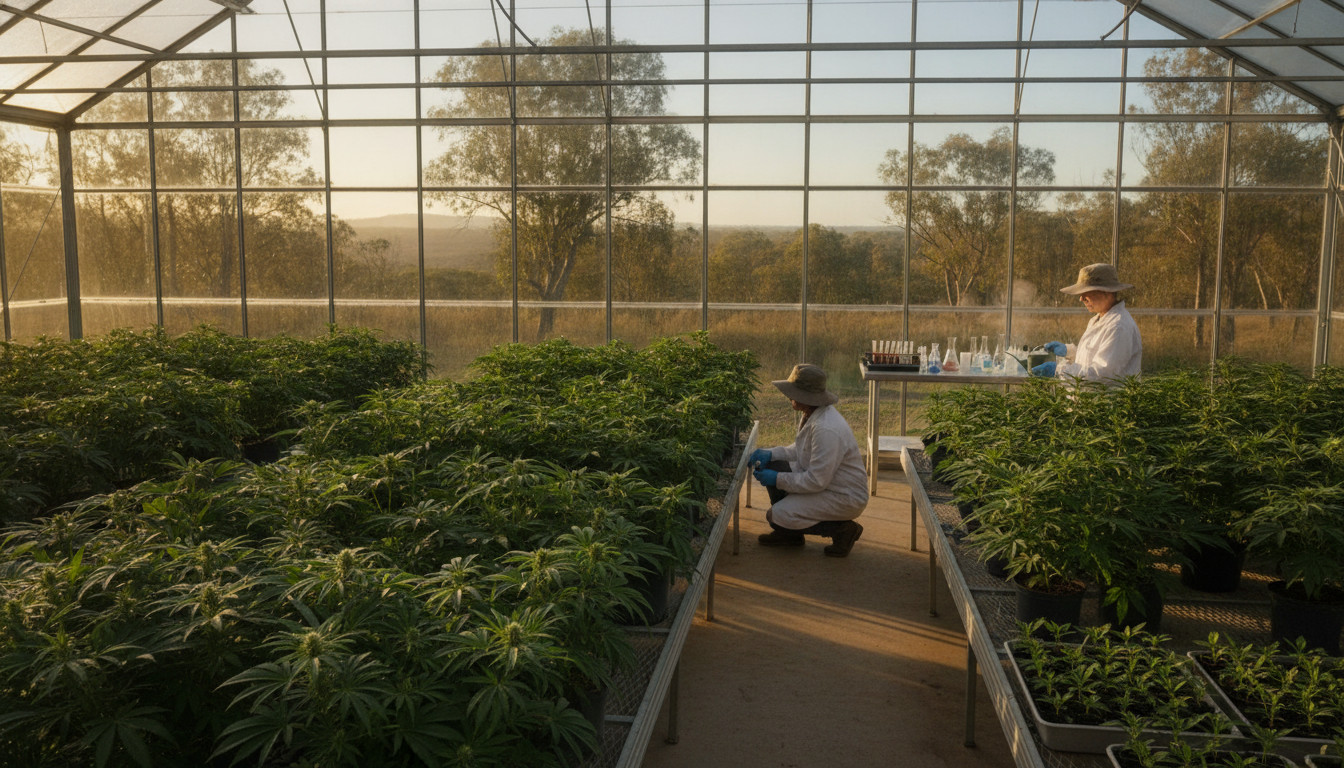
Khalifa Kush expands into the Australian medical cannabis market, and this greenhouse image captures local cultivation and research energy. The photograph shows healthy plants and modern benches, suggesting scale and quality. Because Australia balances tight regulation with rising patient demand, visual cues of innovation matter for credibility.
Khalifa Kush Product Range for Australia
Khalifa Kush expands into the Australian medical cannabis market by introducing a targeted product range adapted for clinics and pharmacies. Because of strict regulation, the portfolio emphasises tested flower, proprietary genetics and dose-controlled edibles. Below is a comparative table showing the planned product types, cannabinoid profiles and intended medical uses.
| Product Name | Product Type | THC/CBD content | Intended Medical Use or Benefits |
|---|---|---|---|
| Khalifa Kush Flower (imported strains) | Flower | Strain-dependent; includes high-THC, balanced THC:CBD and low-THC/high-CBD profiles | Chronic pain relief, nausea control, appetite stimulation, sleep support, individualized by clinician |
| Proprietary Genetics (licensed strains) | Seed stock / genetics licence | Defined cannabinoid chemovars; standardised profiles for consistency | Enables consistent production, research use and predictable dosing |
| Khalifa Kush Edibles (dose-controlled) | Edibles (capsules, lozenges) | Fixed-dose formulations; low to moderate THC and CBD options | Chronic pain support, anxiety management, long-duration symptom control, simpler dosing |
Compliance checklist and timeline
Below is a concise compliance checklist with estimated durations to support the TGA approval process and supply forecasting. Each item shows a typical time range and one concrete document example for submissions or inspections.
- TGO 93 compliance — 2 to 6 weeks for gap analysis and lab data review; example document: certificate of analysis and TGO 93 compliance report. See the TGO 93 guidance for specific standards here.
- GMP certification confirmation — 4 to 12 weeks to verify manufacturer GMP status and corrective actions; example document: GMP certificate or recent GMP audit report.
- ODC import licence and per consignment permit — 2 to 8 weeks to obtain licence then 3 to 7 days per shipment for permits; example document: completed ODC import licence application form. Refer to ODC import guidance here.
- TGA notifications and Special Access Scheme filings — same day to 4 weeks depending on complexity; example document: SAS Category B submission or Authorised Prescriber dossier.
- Pharmacovigilance setup and safety systems — 4 to 8 weeks to implement reporting workflows and local contact; example document: pharmacovigilance plan and safety database extract noting pharmacovigilance reporting obligations.
Step by step timeline for a first shipment
- Internal compliance and TGO 93 checks 2 to 6 weeks
- GMP confirmation and stability testing 4 to 8 weeks
- ODC import licence then consignment permit 2 to 8 weeks plus 3 to 7 days per shipment
- TGA notifications, SAS filings then distribution 1 to 4 weeks
Maintain active pharmacovigilance reporting during supply and update records per TGA guidance and track progress on our market monitoring and updates page here and the TGA adverse event obligations here.
CONCLUSION
Khalifa Kush expands into the Australian medical cannabis market. This move brings tested flower, proprietary genetics and dose-controlled edibles to clinics and pharmacies. Because the company partners with Endoca, supply chain compliance and market entry speed should improve.
Patients gain greater product choice and clinicians gain standardized options for prescribing. However, pricing, local cultivation debates and state scheduling could slow nationwide uptake. MyCBDAdvisor will monitor regulatory outcomes and patient access at MyCBDAdvisor.
Frequently Asked Questions (FAQs)
Will Khalifa Kush products be available nationwide?
Khalifa Kush expands via Endoca to pharmacies and clinics across all states and territories. However actual availability will depend on import permits, TGA approvals and state scheduling. Patients should expect staggered rollout per region.
Are Khalifa Kush products legal and regulated?
Yes, medicinal products must comply with TGA standards and import controls. Therefore products will follow Special Access Scheme or Authorised Prescriber pathways. Clinicians must register prescriptions per state rules.
What types of products will be offered and their benefits?
The range includes flower, dose-controlled edibles and licensed genetics. These products may help chronic pain, nausea, appetite and sleep. Clinicians will tailor choices per patient needs.
How will this expansion affect pricing and local growers?
Imported branded products may apply price pressure on local producers. However import costs, testing and compliance can keep prices higher. As a result, local growers may seek quality or niche differentiation.
What should patients and prescribers do?
Patients should speak to their prescriber about suitability and dosing. Prescribers should verify access pathways and product testing documentation. Finally, track outcomes and report adverse events promptly.
Related on CBD Advisor
- Wiz Khalifa smoked with Latin America’s biggest rap star?✨
- Wiz Khalifa smoked with Latin America’s biggest rap star? 🔥🔥
- Wiz-Khalifa-meets-Duki-and-smokes-a-joint-in-Puerto-Rico: Will Latin crossover redefine hip-hop