
Discovering kava flavors can feel like exploring a dense spice market, joyful and slightly baffling. Because tasting notes range from earthy to floral and include numbing sensations, many people need a shared vocabulary. The Kava flavor wheel aims to make that vocabulary simple and repeatable.
First, it breaks down the wheel’s seven flavor families and 35 descriptors. It will give you a clear map of tasting terms, the wheel’s origins, and practical steps for kava bars, product labeling, and consumer education.
What Is the Kava Flavor Wheel?
The Kava flavor wheel is a visual lexicon that organizes taste and aroma descriptors for kava. Its purpose is to standardize sensory evaluation, help tasters describe flavors, and guide product labeling and consumer education, according to sensory science from USDA research.
How Does the Kava Flavor Wheel Work?
It arranges sensory terms into hierarchical groups so tasters can move from general families to specific descriptors. At its core are seven flavor families, 35 descriptors, a mouthfeel wheel, and a defect wheel, mirroring established sensory methods described by the Institute of Food Technologists.
Lead-in: The wheel helps identify distinct kava flavors by doing the following:
- Group flavors into seven families
- Link aroma notes to taste descriptors
- Provide clear sensory vocabulary
- Show mouthfeel and texture cues
- Flag defects and off-flavors
- Guide panel training and consumer tasting
Because it maps broad sensations to precise terms, the wheel reduces confusion and improves communication between producers, kava bars, and consumers. Therefore, it supports better labeling, more consistent tasting notes, and clearer consumer education.
Kava Root and Traditional Preparation
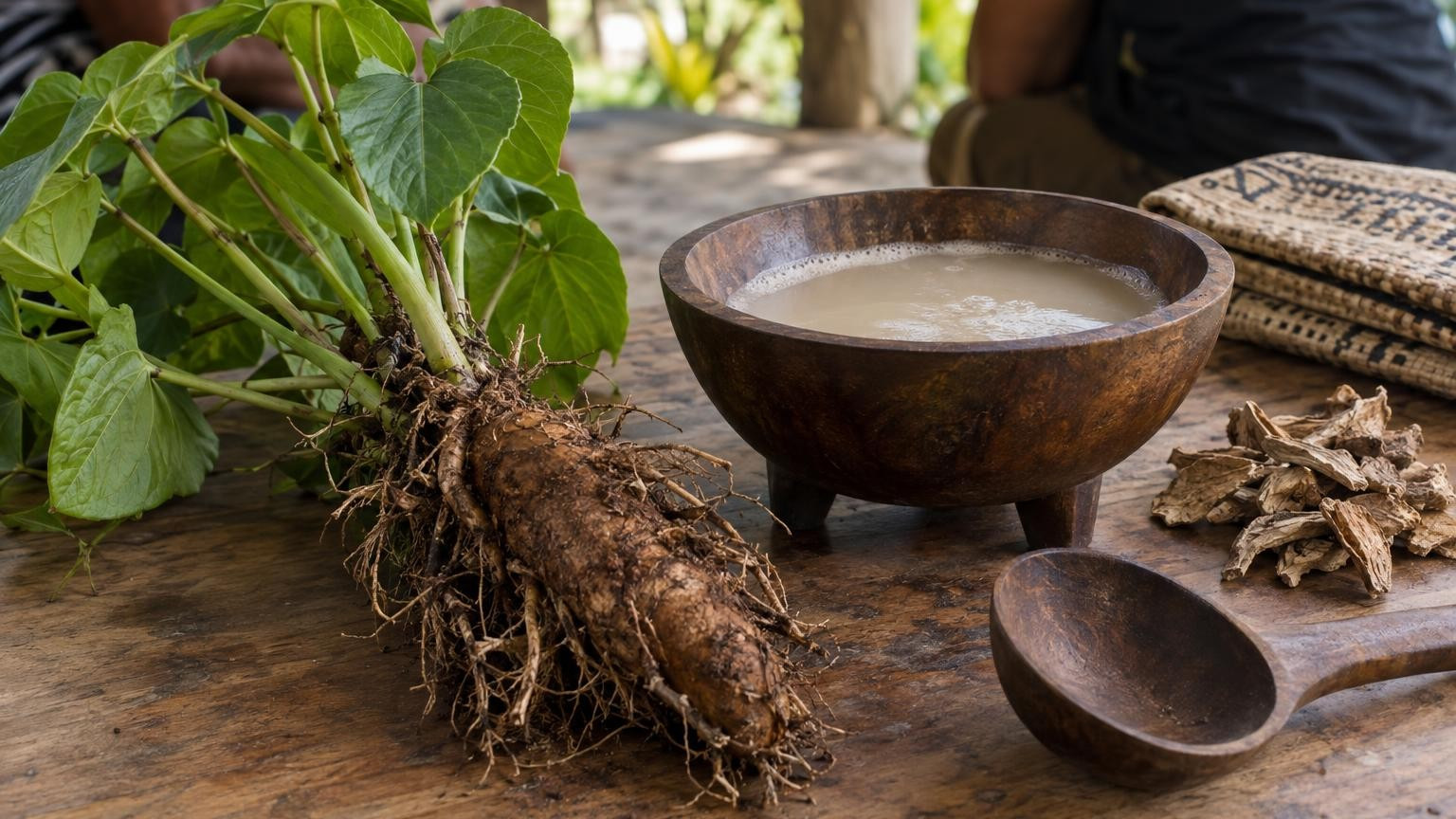
The kava drinking tradition starts with the kava root, the peeled or dried roots and rhizomes of Piper methysticum. Because the root contains water-soluble kavalactones, preparation method shapes both effect and flavor.
Traditional methods use simple, water-based extraction. Roots are washed, pounded or chewed into a pulp, then mixed with ambient-temperature water and filtered through cloth, producing an opaque beverage that carries plant oils and aromas (see a description of traditional preparation methods).
Typical tasting notes include:
- Earthy and root-like
- Woody or timber hints
- Nutty or cashew finish
- Mild bitter or astringent backnote
- Herbal, floral, or piney top notes
- Peppery tingle and lip numbness
Because preparation concentrates or mutes specific compounds, the Kava flavor wheel helps tasters convert sensations into words. The wheel ties aroma, taste and mouthfeel together. Therefore it clarifies whether bitterness comes from the plant or from processing. A clinical review also notes that drying and solvent extraction change sensory profiles and bitterness in commercial products.
Historically, Pacific communities recorded kava use across ceremonies and daily life, and colonial-era catalogs noted its flavors. As a result, the flavor wheel links this cultural lineage with a usable sensory vocabulary for growers, bars, and consumers.
Kava Flavor Wheel vs Other Botanical Flavor Wheels
Because each wheel serves different industries, readers will learn how the Kava flavor wheel stacks up against coffee, tea, and cannabis wheels.
| Feature | Kava flavor wheel | Coffee flavor wheel | Tea flavor wheel | Cannabis flavor wheel |
|---|---|---|---|---|
| Primary focus | taste, aroma, mouthfeel, defect wheel | aroma, taste, roast and origin notes, defect markers | aroma, taste, astringency, terroir and processing notes | aroma and terpene-driven notes, effects and safety |
| Complexity and scale | Seven flavor families and 35 descriptors; plus mouthfeel and defect wheels | Multi-tier hierarchy with many specific descriptors; industry-standard | Multi-layer descriptors covering varietal and processing notes | Evolving taxonomy focused on terpenes and aroma descriptors |
| Typical use cases | kava bars, product labeling, panel training, consumer education | cupping, roast profiling, quality control, consumer guides | sourcing, blending, grading, tasting education | product labeling, strain description, terpene profiling, compliance |
| Sensory dimensions covered | taste, aroma, mouthfeel, peppery tingle and numbness, defects | aroma, taste, acidity, body, mouthfeel, roast faults | aroma, taste, mouthfeel, astringency, off-flavors | aroma, taste, mouthfeel, psychoactive effects, contamination flags |
| Validation and status | proposed framework; panel validation pending | widely validated and used by industry bodies | established references and industry practices | actively evolving with growing research and standards |
Is Using the Kava Flavor Wheel Safe?
Yes. The flavor wheel is a descriptive tasting tool and safe to use because it only involves sensory evaluation and language. However, tasting kava is not risk-free because the drink contains active kavalactones that produce sensations.
The wheel itself simply organizes taste, aroma and mouthfeel terms so tasters can agree on descriptors. For context, classic reviews describe kava’s bitter, numbing and astringent sensations and link them to kavalactones and traditional preparation methods.
See a comprehensive kava review for clinical and sensory context: Kava Overview. Therefore, bars and panels should pair the wheel with safe consumption guidance.
How Long Does Flavor Last in Kava?
Flavor and mouthfeel typically persist for minutes, while numbing and tingling can last longer depending on dose and preparation. Factors that influence sensory duration include kavalactone concentration, root fraction, and extraction method.
Analytical studies show that kavalactone levels vary widely between traditional aqueous infusions and commercial extracts, which helps explain differences in flavor persistence and intensity (see kavalactones assessment). Because processing concentrates or reduces certain compounds, preparation often determines whether bitterness or residual mouthfeel lingers.
Is the Kava Flavor Wheel Worth Using?
Yes, it standardizes tasting language for kava bars, producers, sensory panels, and curious consumers. Therefore the Kava flavor wheel is worth using because it improves labeling and tasting consistency.
Kava bars, producers, and educators benefit most because the wheel creates shared descriptors, trains staff, and standardizes product copy. As a result, consumers get clearer expectations and more useful tasting notes.
However, the wheel is a proposed framework and not yet panel-validated. Because it simplifies complex cultural descriptions, users should pair it with local knowledge and ongoing validation.
Final Thoughts
Adopting the wheel brings clear benefits for labeling, tasting, and customer education while noting the framework is proposed, not final.
Therefore, producers, kava bars, and educators should use the wheel to standardize descriptions, yet remain open to refinements from scientific panels.
A practical next step is to run staff tasting sessions using the wheel, record language choices, and support formal panel validation.