The UK-EU CBD regulatory transition is reshaping the legal landscape for cannabinoid products across Britain and the European Union. Because regulators are aligning with stricter EU food safety rules, many brands must rethink formulas and labels. However, differences remain in current thresholds, with the FSA using a 10 mg daily intake and EFSA advising about 2 mg. This mismatch creates regulatory uncertainty for manufacturers and retailers. At the same time, the shift offers clear opportunities for firms that act early.
Companies that plan supply chains and reformulation now can gain market advantage. Consumers may benefit from harmonized safety standards and clearer product information. Yet smaller producers face higher compliance costs and longer approval timelines. Therefore, supply disruptions and product withdrawals could follow in the near term.
Moreover, industry groups like EIHA are coordinating large portfolios through the novel foods process. As a result, some products may need temporary reformulation to meet differing intake limits. The next two years will test the industry’s agility, legal strategy, and product innovation.
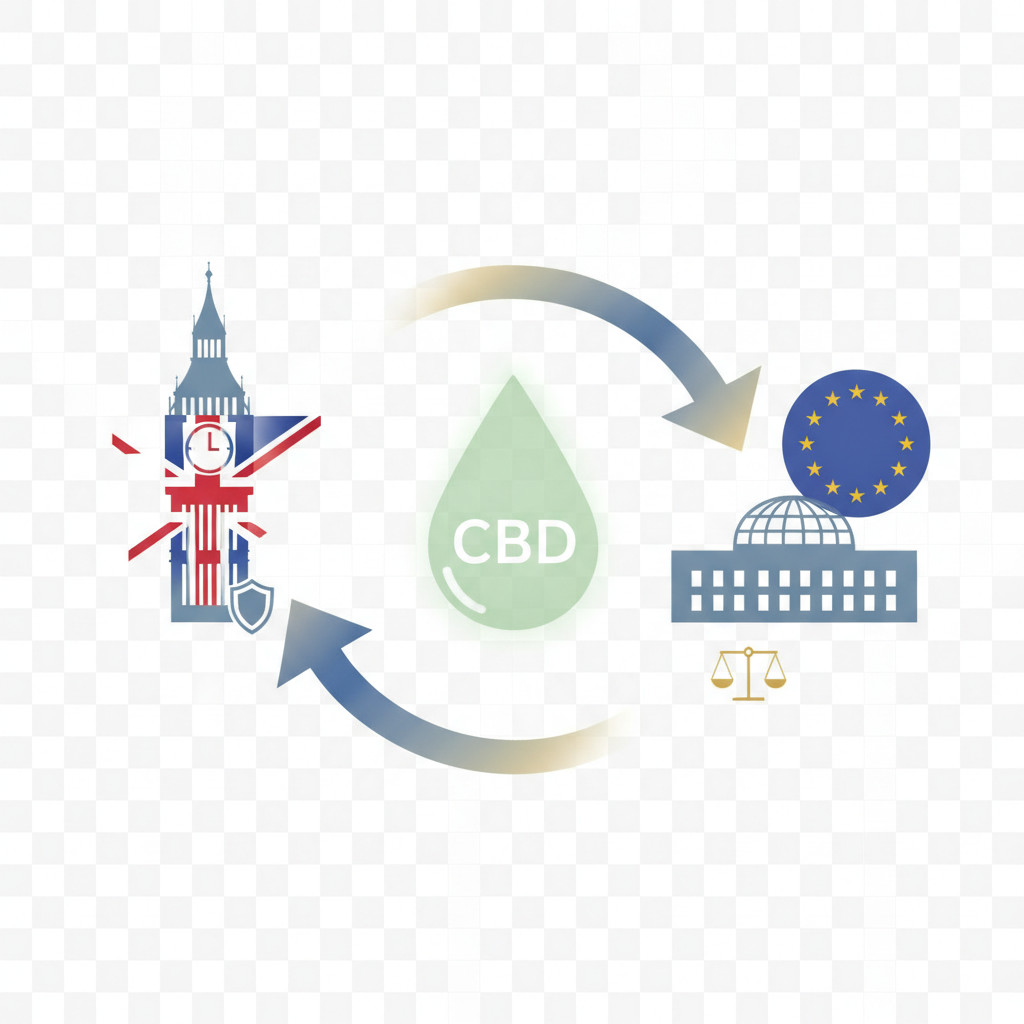
Key regulatory differences in the UK-EU CBD regulatory transition
Post-Brexit, the United Kingdom and the European Union use different regulatory paths for cannabidiol products. As a result, businesses face diverging approval routes, intake thresholds, and compliance checks. The UK uses reviews led by the Food Standards Agency and Food Standards Scotland, followed by ministerial decisions. By contrast, the EU relies on EFSA scientific opinions and a Commission implementing act to add products to the Union list.
Because thresholds differ, product formulation is a key pain point. The FSA has used a 10 mg daily intake benchmark. Meanwhile EFSA set a much lower provisional level near 2 mg per day. Therefore, products authorised in the UK may need reformulation to meet EU rules later. For more on the UK guidance, see UK guidance on CBD. For EFSA updates, see EFSA news.
How the UK-EU CBD regulatory transition affects approvals, marketing, and compliance
Product approvals
- UK approvals follow the FSA/FSS Market Authorisation Service and end with ministerial authorisation. Consequently, timelines can hinge on policy windows.
- EU authorisations require EFSA safety assessment and an implementing act to add items to the Union list. Thus, the EU route can be slower but more uniform across member states.
Marketing and labelling
Marketing claims must reflect the authorised use and intake limits. If a UK brand exports to the EU, it must adopt EU conditions of use and labelling. As a result, firms should prepare dual-label strategies and clear consumer information to avoid enforcement actions.
Legal compliance and risk management
Compliance costs will rise, especially for small producers. In addition, a sanitary and phytosanitary SPS agreement aims to align UK rules with the EU by mid-2027. For practical planning advice, review the GOV.UK SPS guidance. Industry reporting and analysis on the transition are available at HempToday report.
Practical steps for businesses
- Audit product dossiers and labels now because changes can drive withdrawals.
- Prioritise data gaps in toxicology and manufacturing controls to satisfy EFSA-style reviews.
- Consider reformulation for an eventual EU intake limit while monitoring SPS negotiations.
In short, the UK-EU CBD regulatory transition creates both compliance burdens and a chance for harmonised safety. Businesses that act early can reduce disruption and protect market access.
| Aspect | United Kingdom (UK) | European Union (EU) |
|---|---|---|
| Legal status | Treated as novel food for foods and supplements. Regulated by FSA and FSS with ministerial decisions. | Generally classed as novel food. EFSA provides scientific opinion and the Commission adds items to the Union list. |
| THC limits | Requires minimal nonpsychoactive THC levels. Testing standards and enforcement vary by product and lab. | Requires minimal nonpsychoactive THC levels. Specific limits and detection thresholds vary by member state and method. |
| Novel food status | Novel food application required for new CBD uses. Dossiers go to the FSA/FSS Market Authorisation Service. | Novel food application required. EFSA safety assessment and Commission implementing act set conditions of use. |
| Product labeling | Must list ingredients, use instructions, and intake guidance. Medical claims prohibited; follow UK food law. | Must follow EU food labelling rules. Claims and conditions of use must match Union list entries. |
| Import and export rules | Post-Brexit border checks apply. An SPS agreement aims to align rules by mid-2027; temporary divergence possible. | Imports must meet Union list conditions and EFSA-derived use limits. Customs and food safety checks enforce compliance. |
Because the regimes differ, companies must plan carefully. Therefore use the table to guide compliance and product strategy.
Impact on businesses: UK-EU CBD regulatory transition
The UK-EU CBD regulatory transition forces major operational changes for firms. Because rules diverge now, companies must manage parallel compliance tracks. As a result, some face higher costs and market uncertainty.
Key challenges for businesses
- Compliance costs rise quickly. For example, reformulation and retesting add lab and consultancy fees. Smaller brands often lack the cash to absorb those costs.
- Market access restrictions can occur without unified approvals. Consequently, a product authorised in the UK may not meet EU conditions of use.
- Longer approval timelines slow launches. The EU novel foods process needs EFSA assessment and a Commission act, while the UK route ends in ministerial decisions.
- Supply chain complexity increases because sourcing and customs checks may change after Brexit. The planned SPS agreement aims to align rules by mid-2027, but delays will prolong friction. See GOV.UK guidance on SPS planning.
- Portfolio risk grows for applicants. Industry groups report thousands of products in the pipeline, and some applications have already dropped out. For context, industry coverage of the shift is available at Hemp Today coverage.
Practical business responses
- Audit dossiers and patch data gaps now. Prioritise toxicology and manufacturing controls.
- Plan for dual labelling and conditional marketing across territories.
- Consider staged rollouts that prioritise markets with clear authorisations.
Impact on consumers: UK-EU CBD regulatory transition
Consumers will feel both benefits and downsides from the transition. On the one hand, harmonised EU-style rules can raise safety standards. On the other hand, availability and price may suffer.
What consumers should expect
- Safer product standards because EFSA-style reviews push clearer safety thresholds. For EFSA updates, see EFSA news.
- Potential reductions in product choice. If firms withdraw or pause products, shoppers may find fewer options.
- Price increases due to higher compliance and reformulation costs.
- Confusing intake guidance while FSA and EFSA thresholds differ. The FSA has used a 10 mg daily intake guide, while EFSA suggested about 2 mg. Learn more at FSA guidance.
Consumer tips
- Check labels for authorised use and intake limits.
- Buy from reputable brands with transparent testing.
- Watch for product updates as SPS negotiations and Union list additions progress.
Overall, the UK-EU CBD regulatory transition raises short-term disruption. However, it also drives clearer standards and product safety in the medium term.
The UK-EU CBD Regulatory Transition
The UK-EU CBD regulatory transition demands agility from brands and clarity for consumers. Because intake thresholds and approval routes diverge, firms must revise formulations and dossiers. However, harmonised rules promise clearer safety standards in time.
Key takeaways
- Immediate action: audit product dossiers and close data gaps to avoid withdrawals.
- Therefore, expect short-term costs from reformulation, retesting, and dual labelling.
- As a result, smaller producers may face market exits without funding or technical support.
- Also, proactive firms can gain advantage through innovation and robust safety data.
Follow novel foods guidance, EFSA and FSA assessments, and SPS agreement updates. Stay informed, adapt quickly, and prioritise safety to protect market access and consumer trust.
Frequently Asked Questions (FAQs)
What is the UK-EU CBD regulatory transition and why does it matter?
The UK-EU CBD regulatory transition refers to the UK moving toward EU food safety rules for cannabidiol products. Because EFSA has suggested a provisional intake around 2 mg, while the FSA used 10 mg, intake limits will change. This matters because approvals, labelling and market access depend on those limits.
How will product approvals change for businesses?
Approvals in the UK follow FSA/FSS review and ministerial decision. EU approvals need an EFSA safety opinion and a Commission implementing act. Therefore companies may face two parallel approval tracks and longer timelines. Firms should prioritise robust safety dossiers and manufacturing controls.
Will my favourite CBD products disappear or become reformulated?
Some products may be withdrawn or reformulated. Smaller brands often lack funds to reformulate quickly. However larger consortia like EIHA Projects GmbH coordinate thousands of applications. As a result, consumers may see fewer SKUs and revised intake guidance.
What steps should businesses take now?
Audit novel foods dossiers and testing data immediately. Close toxicology and stability gaps. Plan dual labelling and conditional marketing for UK and EU markets. Also monitor the SPS agreement progress on GOV.UK at SPS Agreement Guidance. For technical updates see EFSA at EFSA News and FSA guidance at FSA Guidance.
How can consumers stay safe and informed?
Check product labels for authorised use and intake limits. Buy tests and certificates from trusted brands. Follow independent coverage such as HempToday at HempToday Coverage. Above all, watch for updates as Union list additions proceed.