
U.S. Cannabis Market Collapse
The U.S. cannabis market collapse blamed on Canadian investment bankers has become the leading explanation for recent turmoil. Investors, regulators, and former executives cite an influx of overzealous Canadian capital that inflated valuations and deal activity. Banks pushed roll-ups, buyouts, and large public listings despite weak revenue fundamentals.
As a result, firms built costly extraction plants and robotic facilities they could not afford to run. Meanwhile, bankers collected underwriting fees and advisory payouts while risks stacked up on borrower balance sheets. Today, bankruptcy filings, receiverships, and delistings record the aftermath across multiple states and exchanges.
This piece traces capital flows and untangles the roles of underwriting, overcapitalization, and regulatory gaps. It also examines how taxes, the black market, and policy uncertainty amplified shocks for operators. We use postmortems, case studies, and market data to show how leverage wrecked parts of the sector. Read on for a detailed, critical review of what went wrong.
U.S. cannabis market collapse blamed on Canadian investment bankers
Canadian investment bankers played a central role in the sector’s boom and bust. They underwrote listings, pushed cross-border roll-ups, and marketed aggressive growth stories. As a result, valuations detached from fundamentals. Because banks earned underwriting and advisory fees, they often favored deal volume over company sustainability. However, those same deals left operators with unsustainable debt and bloated capital structures.
Bank-led strategies drove overcapitalization in several ways. First, bankers promoted rapid public listings on the Canadian Securities Exchange and TSXV to capture retail excitement. Second, they advised large-scale builds and high-end extraction projects, which raised fixed costs. Third, bankers packaged roll-ups that aggregated weak assets into larger entities. For context, big institutional moves, such as Constellation Brands’ investment in Canopy Growth, signaled market potential and encouraged outsized bets here. As a result, capital flooded the industry, and many firms spent on excess capacity and robots they did not need.
Financial tactics included aggressive valuations, prepaid earnouts, and complex debt structures. Moreover, underwriting fees and placement commissions rewarded dealmakers even when transactions later failed. Therefore, the banking model created a moral hazard where short-term gains outlived company viability. For a record of major capital commitments, see the Constellation press release archive here.
Key points
- Banks prioritized roll-up and go-public strategies, driving market momentum and risk
- Underwriting and advisory fees encouraged high-volume transactions, not long-term health
- Overvaluation led operators to overbuild facilities and buy excess extraction equipment
- Complex financing and earnouts saddled firms with debt and contingent liabilities
- As a result, bankruptcies, receiverships, and delistings followed across exchanges
Related keywords and synonyms: Canadian bankers, overcapitalization, roll-up-go-public, CSE, TSXV, overvaluation, cannabis extraction equipment, bankers’ fees, moral hazard
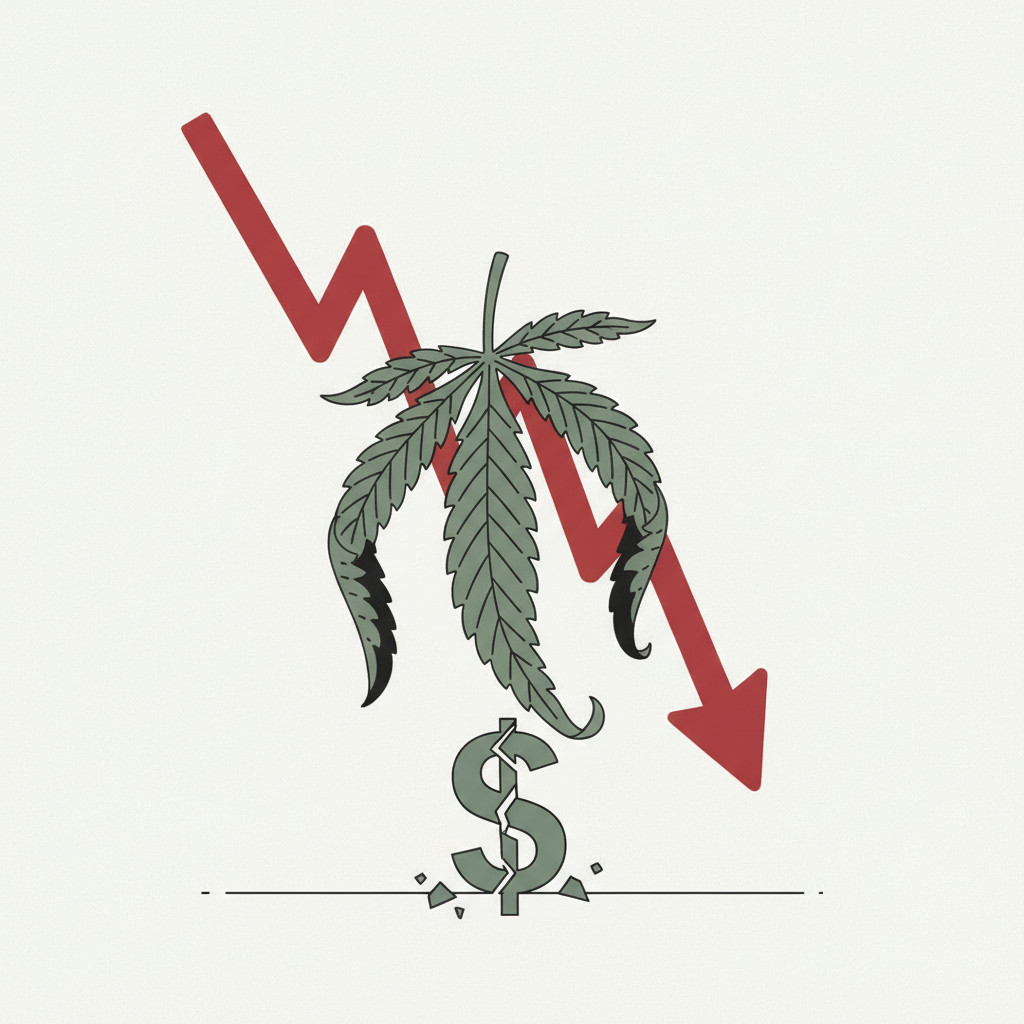
U.S. cannabis market collapse blamed on Canadian investment bankers
The collapse hit operators and investors hard. California retail sales slid from near peak levels, and tax receipts showed quarterly drops, underlining weaker demand and pricing pressure. For official tax data and quarterly figures, see the California Department of Tax and Fee Administration report. As a result, many firms saw cash flow stress and rising insolvency risk.
Investor sentiment turned negative because headline failures and complex financing emerged. Surveys showed risk appetite fell sharply in 2024, then only slowly recovered in 2025; see the ATB investor sentiment survey. Meanwhile cannabis stock indices fell, amplifying paper losses and margin calls for leveraged holders source.
Key impacts
- Liquidity crunch for operators led to layoffs and canceled expansion projects
- Bankruptcies and receiverships removed equity value from common shareholders
- Retail demand shifted to lower priced products, squeezing gross revenue margins
- Investors faced steep paper losses and weaker exit prospects for private deals
- Creditors recovered small fractions, while dealmakers often kept fees
Overall, firms that carried heavy fixed costs and complex debt collapsed faster. Therefore, the collapse reshaped investor caution and industry consolidation.
Comparison of investment factors before and after the U.S. cannabis market collapse blamed on Canadian investment bankers
| Factor | Pre-collapse scenario | Post-collapse scenario | Impact on market perception |
|---|---|---|---|
| Valuations | Rapid multiple expansion, often based on narrative rather than revenue. | Sharp re-rating, with many stocks losing most market value. | Trust declined; investors now demand real earnings. |
| Capital allocation | Heavy spending on extraction, robots, and large facilities. | Capex cuts, asset sales, and halted projects. | Perception shifted to prior overinvestment and waste. |
| Financing structures | Complex earnouts, convertible notes, and high leverage. | Defaults, restructurings, and creditor-led takeovers. | Lenders and investors now view the sector as risky. |
| Deal activity | Frequent roll-ups, mergers, and aggressive IPOs on CSE/TSXV. | Consolidation through bankruptcies and distressed sales. | Skepticism toward roll-up strategies increased. |
| Liquidity & exits | Active secondary markets and retail trading enthusiasm. | Reduced liquidity and poor exit prospects for private deals. | Exit windows narrowed; valuations became conservative. |
| Investor sentiment | Retail-driven optimism and FOMO fueled buying. | Risk aversion and flight to cash or staples. | Market sentiment turned cautious and defensive. |
| Regulatory signal | Cross-border capital flows masked U.S. banking limits. | Regulatory and tax challenges exposed structural weaknesses. | Confidence in long-term growth now tempered. |
CONCLUSION
The U.S. cannabis market collapse blamed on Canadian investment bankers exposed a pattern of overcapitalization and weak underwriting. Banks marketed roll-ups, aggressive listings, and high-fee deals despite thin revenue. As a result, firms overbuilt facilities, bought excess extraction equipment, and accumulated complex debt. Bankruptcy filings, receiverships, and delistings followed, wiping out common equity while bankers collected fees.
Lessons learned are clear and urgent. First, capital must match operating economics, not hype. Second, fee structures should align with long-term company health because short-term incentives caused moral hazard. Third, regulators and investors must require transparent earnouts and stress-tested models. Therefore, tighter governance and better disclosure are essential.
Frequently Asked Questions (FAQs)
What caused the U.S. cannabis market collapse?
The collapse resulted from overcapitalization and aggressive banking practices. Canadian investment bankers promoted roll-ups and rapid listings. They pushed high valuations disconnected from revenues. Firms invested in costly extraction equipment and robots. Debt and complex earnouts followed. As a result, many operators faced insolvency when revenue lagged. Also, policy uncertainty and a persistent black market amplified the strain.
How did Canadian bankers influence capital allocation?
They advised large public offerings on the CSE and TSXV, attracting retail money. Banks collected large underwriting fees, which created perverse incentives. Therefore they favored deal volume over sustainable business models. Bank-led roll-ups bundled weak assets into larger firms. Consequently, companies carried excess fixed costs and idle capacity. Retail enthusiasm and media narratives further inflated valuations.
What were the main effects on businesses and investors?
Cash flow shortages forced layoffs and capex cuts. Bankruptcy filings and receiverships rose across multiple jurisdictions. Common shareholders lost most equity value, while creditors and advisers recovered more. Investor sentiment turned risk averse, which reduced liquidity and secondary market activity. Pension funds and institutional holders tightened exposure because losses mounted.
Can the sector recover, and what will drive resilience?
What should investors watch for next?
Watch valuation versus revenue, not narratives. Monitor balance sheet strength, cash burn, and covenant terms. Check governance and fee alignment for bankers and advisers. Prefer companies with modest fixed costs and realistic growth forecasts. Also watch legal developments and banking access for licensed operators.