Cannabis regulation and cross-state market dynamics in the US
This article maps how policy choices create local market effects. For example, Missouri’s hemp debate and proposed limits on THC per container affect nearby sellers. Moreover, the Northeast corridor shows a different pattern with New Jersey and New York driving rapid retail growth. As a result, brands think regionally while regulators act locally.
We will unpack the legal patchwork, including intoxicating hemp rules, federal shifts, and filibuster moments. Then we analyze market outcomes such as cross-border branding, retailer saturation, and micro-license strategies. Finally, we offer forward-looking insight for policymakers, operators, and consumers navigating this evolving ecosystem.
Cannabis regulation and cross-state market dynamics in the US
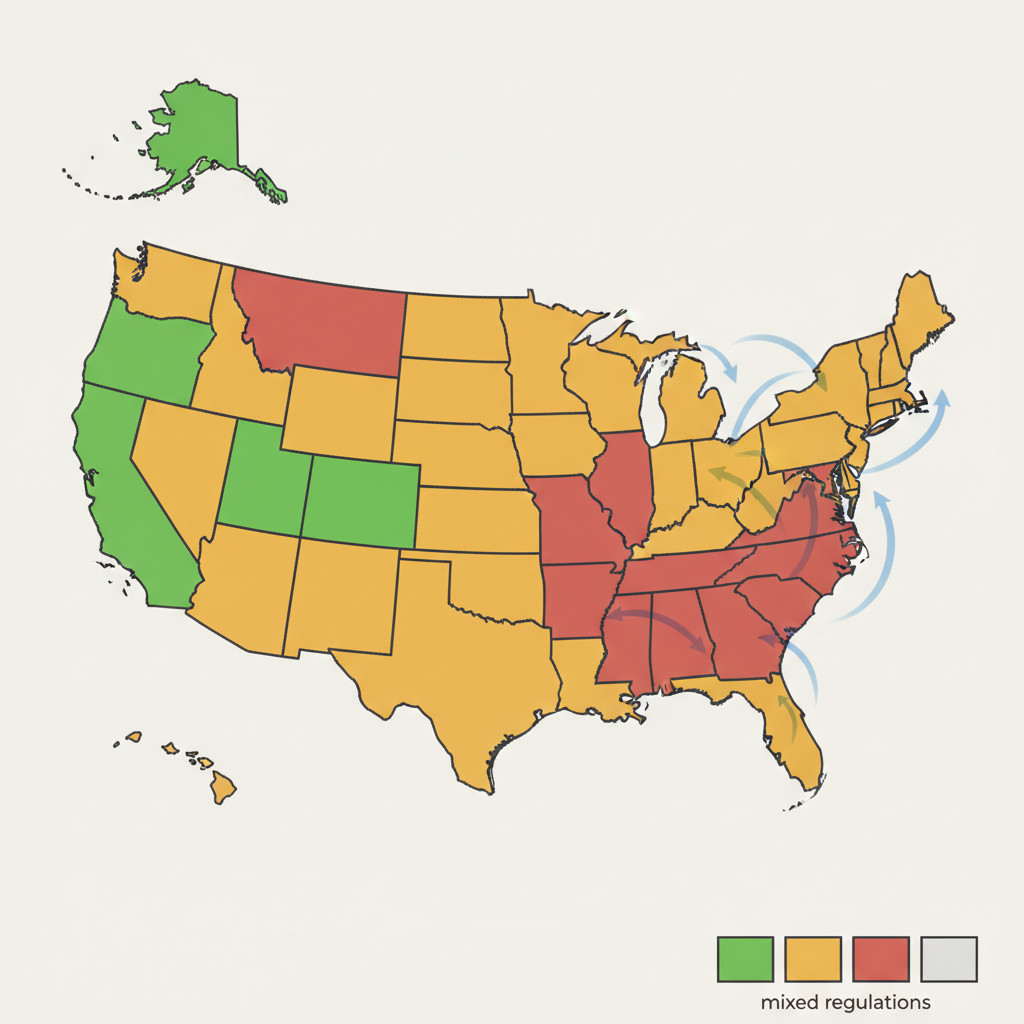
The U.S. cannabis market sits under overlapping rules. Federal hemp law sets a baseline, while states write the rest. Because state laws diverge, businesses and consumers face a patchwork of access, testing, and labeling rules.
Key regulatory frameworks and how they work
- Federal hemp and THC standards
- In 2025 and 2026, federal rules tightened THC limits. Specifically, hemp is defined to include all THCs at no more than 0.3 percent on a dry weight basis. Moreover, final products face a 0.4 milligram THC per container limit. Therefore, many hemp-derived products face new national constraints. For details, see this article.
- State legalization categories
- States fall into three broad groups: adult-use legal, medical-only, and effectively illegal. For example, Colorado and California allow adult-use sales. Meanwhile, many Midwestern and Southern states restrict most forms of cannabis. For a state-by-state overview, consult NORML’s laws page.
- Licensing and market structure
- States vary who can sell and how businesses operate. Some use broad adult-use licenses. Others favor micro-license schemes to boost local firms. In Missouri, policy debates over intoxicating hemp products show how licensing can limit out-of-state supply. Consequently, in-state cultivation rules often shape where products originate.
- Testing, packaging, and enforcement
- States require different lab testing standards and labeling rules. Therefore, a product legal in one state may fail testing in another. Because of this, supply chains fragment and compliance costs rise.
How regulatory differences change markets and consumer behavior
- Pricing and availability
- Price varies by state because supply pools differ. For instance, strict hemp limits raise costs and reduce product variety. As a result, consumers cross borders to find lower prices or preferred brands.
- Cross-border flows and branding
- Neighboring markets create bi-directional pressure. New York and New Jersey show rising retail demand that spills across state lines. Meanwhile, brands expand regionally to capture broader audiences. For insight on delta nine market moves, see this analysis.
- Market concentration and competition
- Where rules favor large operators, small brands struggle. Conversely, micro-license regimes can let small-batch brands thrive. Therefore, regulatory design directly shapes competition.
- Consumer choices and risks
- Consumers react to availability and price. As a result, demand can shift between licensed products and unregulated alternatives. Moreover, inconsistent labeling raises safety concerns.
In short, regulation drives where products move and how markets price them. As a result, operators must navigate both local rules and regional demand to succeed.
Cannabis regulation and cross-state market dynamics in the US: state snapshots
Below is a compact comparison of five states that highlights how laws differ. This table shows legality status, permitted product types, typical possession limits, and tax structure. Use it to see why cross-border trade and pricing vary so much.
| State | Legal status | Permitted product types | Typical possession limits (adult-use) | Tax structure and notes |
|---|---|---|---|---|
| California | Adult-use legal | Flower, edibles, concentrates, tinctures, topicals | Up to one ounce of flower; concentrates limited by weight and mg THC per package varies by product | State excise tax on retail sales plus state and local sales taxes; additional local taxes vary by city and county |
| Colorado | Adult-use legal | Flower, edibles, concentrates, infused products | Up to one ounce of usable cannabis; concentrates typically limited to small quantities | State excise and general sales taxes apply; local jurisdictions may add taxes; cultivation taxes exist |
| New Jersey | Adult-use legal | Flower, edibles, concentrates, vape products, medical formulations | Possession limits vary by statute and regulation; small public possession allowed for adults | State levies excise or sales-style taxes; tiered tax structures applied to wholesale or retail depending on product |
| New York | Adult-use legal | Flower, edibles, concentrates, medical products, vape | State rules set possession thresholds for public and private possession; limits vary by setting | State excise and sales taxes apply; local taxes and licensing fees affect final prices |
| Missouri | Medical legal; hemp debated | Medical cannabis, hemp-derived products, tinctures, topicals | Medical patients follow state limits; hemp rules under legislative review and subject to change | Taxation for medical sales differs from adult-use regimes; hemp product restrictions can effectively limit market availability |
Key takeaways
- Regulatory fragmentation creates price gaps and supply mismatches across borders.
- Different testing, packaging, and licensing rules raise compliance costs.
- Tax structures and license types shape who can compete and how products scale.
These contrasts explain why brands pursue regional strategies and why consumers cross state lines for access.
Supply chain fragmentation
Testing and labeling standards differ by state. Producers often must run multiple compliance streams. That increases overhead and slows inventory flow.
- Different lab requirements force duplicate testing. This raises costs and delays shipments.
- Licensing limits and micro-license schemes block scale for some growers. Small operators struggle to serve multiple markets.
- Cross-border transport restrictions make regional distribution risky. Consequently, logistics providers avoid certain routes.
Together these forces fragment distribution networks and push businesses to localize operations.
Price arbitrage
Tax and fee differences create clear price gaps. Consumers respond by shopping across borders or choosing cheaper alternatives.
- High excise taxes inflate shelf prices in some states.
- Retail saturation in mature markets depresses local prices.
- Neighboring low-tax states attract shoppers and reduce demand for high-tax retailers.
Consequently, brands must choose between competing on price or building premium reputation.
These pricing pressures directly influence consumer choices and illicit activity.
Consumer access
Access varies widely by state, affecting patients and recreational buyers. Limited legal options often push people toward unregulated markets.
- Patients in restrictive states may travel across borders for medicine.
- Consumers may rely on black market supply when legal products are scarce or expensive.
- Inconsistent labeling and testing raise safety risks for end users.
This divergence can deepen inequities and reduce local business ownership.
Policy implications
Policymakers face tradeoffs between enforcement and access. Harmonized standards can lower costs and shrink illicit markets.
- Standardize testing and labeling to reduce compliance burdens.
- Consider regional coordination for licensing and transport rules.
- Lower barriers to legal market entry to undercut black market sellers.
In short, targeted policy reforms and regional strategies can improve safety, competition, and access.
Conclusion
Understanding cannabis regulation and cross-state market dynamics in the US matters for consumers and businesses. Because states set different rules, pricing, supply, and access shift across borders. As a result, companies must navigate licensing, testing, and tax gaps. Moreover, consumers sometimes travel or turn to unregulated options when legal access is limited.
Policymakers can reduce market harm by harmonizing testing, labeling, and packaging standards. Businesses should invest in compliance, strong branding, and regional strategies. Consumers should prefer licensed retailers and verify product testing. As a result, these steps can shrink illicit markets and improve safety.
In short, the legal patchwork creates opportunities and risks. Hence, staying informed helps shape better business choices and safer consumer outcomes.
Frequently Asked Questions (FAQs)
What causes differences between state cannabis laws?
State-level legalization choices, licensing rules, and testing standards create the patchwork. Federal hemp law sets a baseline, but states fill most gaps. Consequently, THC limits, permitted product types, and retail models vary by state. For example, hemp-derived delta-8 may be legal in one state but banned in another.
Is it legal to buy cannabis in one state and take it to another?
No. Transporting cannabis across state lines generally violates federal law. Even when both states permit adult use, crossing a border with cannabis remains illegal. Therefore, travelers risk fines, vehicle searches, or prosecution. Always check local rules before traveling with any product.
How do regulatory differences affect prices and access?
Tax rates, license fees, and testing requirements drive prices. High excise taxes raise shelf prices, while low-tax neighbors attract shoppers. Supply limits and retail density change availability too. As a result, consumers sometimes travel to find lower prices or preferred brands.
Do varied rules boost illicit markets?
Yes. Where legal markets stay expensive or limited, illicit sellers fill demand. Unregulated products may lack lab testing and clear labeling. Moreover, enforcement priorities vary across states, which changes illicit activity levels. Policymakers who widen legal access often reduce black market share.
What should businesses and consumers do to navigate this landscape?
Businesses should prioritize compliance, regionally minded supply plans, and strong branding. They should also invest in quality control and clear labeling. Consumers should buy from licensed retailers and review lab reports. Finally, staying informed helps avoid legal and safety risks as rules evolve.