
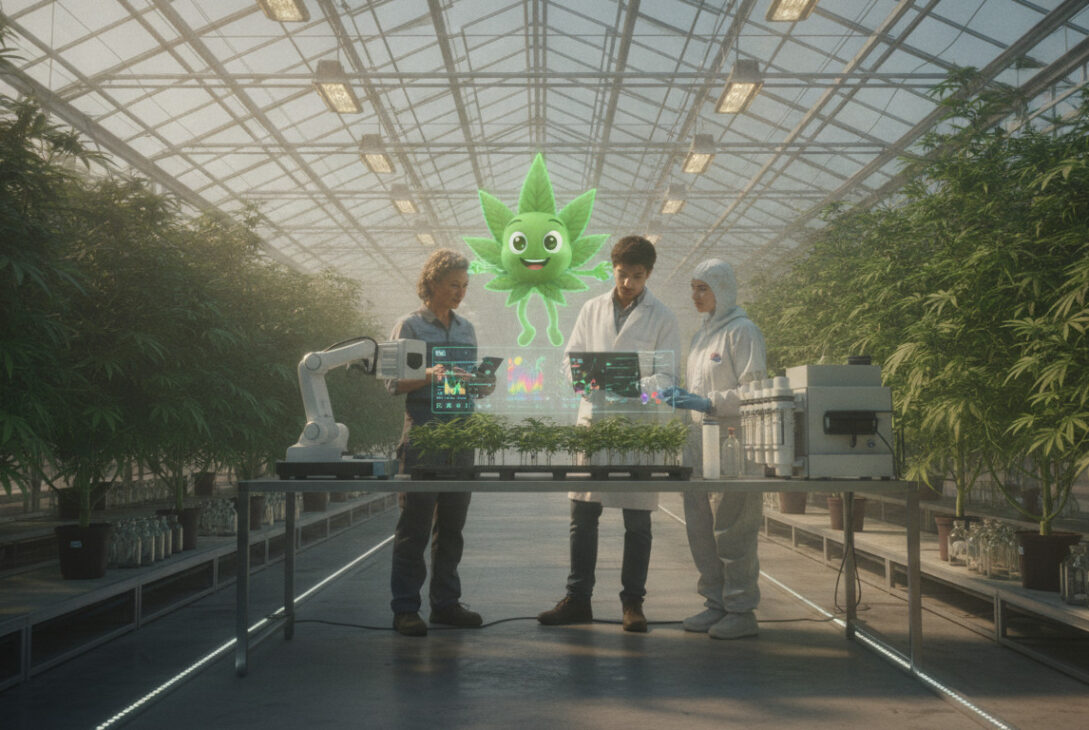
Digital agriculture solutions, including AI, have increased crop yields by up to 31% in some studies source. This article dives into how AI is becoming an indispensable tool for growers, laboratories, and retailers in the cannabis industry.
AI in the cannabis industry is moving from experiment to everyday tool for growers, labs, and retailers. Across the U.S., smarter sensors, machine learning models, and automation are raising yields and cutting waste on commercial farms.
However, the change is complex and requires close attention to quality, compliance, and culture. In greenhouses and indoor rooms, spectral imaging and predictive models flag plant stress early, often before visible symptoms appear. A recent hyperspectral leaf scanning method predicted cannabinoid concentrations weeks ahead with high accuracy source, guiding harvest and processing choices.
Producers can fine-tune feeding, light schedules, and harvest timing to improve potency and uniformity across batches. On the business side, AI automates compliance reporting, inventory forecasting, and customer personalization, saving time and reducing regulatory risk. Yet the tools prompt hard questions about labor, seed diversity, and who owns plant and consumer data.
This article examines how AI reshapes cultivation, breeding, and lab testing, and outlines practical steps operators can take next. The targeted audience includes growers, labs, and retailers looking to innovate in the cannabis space.
What is AI in the cannabis industry?
AI in the cannabis industry uses machine learning and sensors to monitor plants and predict outcomes in real time. As a result, growers apply it for early disease detection, yield optimization, and harvest timing.
Labs use AI for potency prediction and faster, more accurate testing workflows. Meanwhile retailers and operators automate compliance, inventory, and personalized marketing with data driven insights.
Improved Crop Yield and Consistency
- Impact: AI platforms monitor environmental factors such as light and humidity 24/7.
- Example: Continuous plant scanning in large facilities has increased crop yields.
- Metric: Operators report reduced crop loss by utilizing precision agriculture technologies (Purplefarm Spyder deployment report).
Faster, More Accurate Quality Control
- Impact: Hyperspectral leaf scanning combined with machine learning predicts cannabinoid levels weeks in advance.
- Example: Labs can prioritize plants for focused testing based on this predictive data.
- Opportunity: This predictive maintenance approach allows timely adjustments in harvest timing ((hyperspectral leaf scanning study).
Easier Compliance and Operations
- Impact: AI automates seed-to-sale tracking and anomaly detection.
- Example: Operators can allocate more time toward production as they spend less on manual compliance.
- Opportunity: Reducing paperwork burden significantly with AI-driven solutions at times of regulatory changes (New York legalization analysis).
Better Consumer and Inventory Insights
- Impact: Retail systems leverage AI for precise inventory forecasting and targeted marketing.
- Example: Personalized marketing boosts campaign ROI through timely interventions.
- Opportunity: The use of video analytics enhances loss prevention and predictive insights.
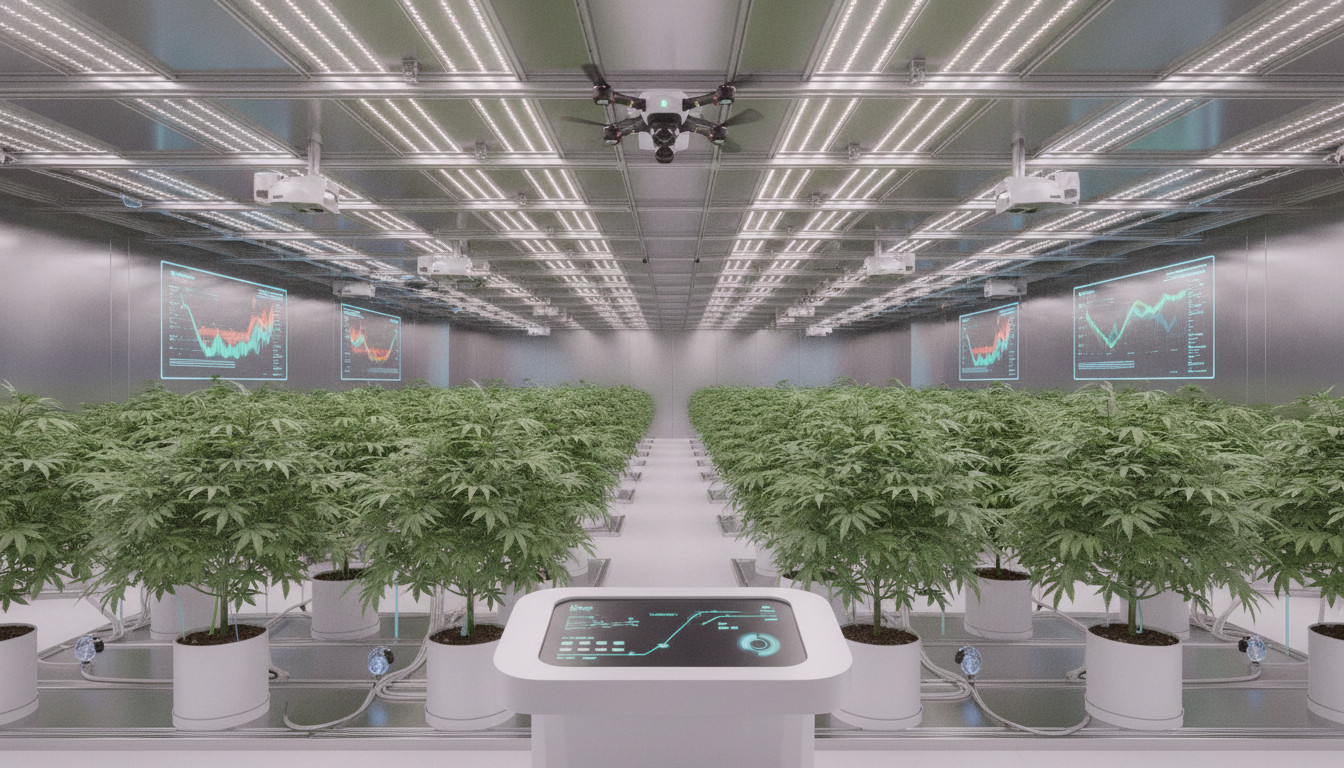
AI in the cannabis industry: standardized tech table
| Technology Name | Description | Benefits to Cannabis Industry |
|---|---|---|
| Machine learning | Supervised and unsupervised algorithms that learn patterns from multi modal cultivation and lab data. | Optimizes feeding, lighting, and schedules to increase yield and uniformity. |
| Computer vision | Camera systems with convolutional models that analyze plant images for health and development. | Detects pests, nutrient deficiencies, and flowering stages before visible symptoms appear. |
| Predictive analytics | Time series and regression models that forecast yield, demand, potency, and operational metrics. | Reduces waste, improves harvest timing, and aligns inventory with demand. |
| Hyperspectral imaging with ML | High resolution spectral scans combined with machine learning to infer chemical composition non destructively. | Predicts cannabinoid and terpene levels weeks before harvest for prioritizing tests. |
| Robotics and automation | Automated trimming, transport, and environmental control machines that execute routine cultivation tasks reliably. | Reduces labor costs, speeds processing, and increases post harvest consistency. |
| Natural language processing | Text and voice models that extract information, answer regulator questions, and automate documentation. | Automates compliance reporting, improves customer chat, and indexes regulatory documents. |
| Anomaly detection and video analytics | Algorithms that flag unusual sensor, climate, or camera events in real time for investigation. | Prevents theft, detects equipment failures, and reduces crop loss risk. |
| Genomic prediction models | Statistical and machine learning models that predict plant traits from genetic marker datasets. | Speeds breeding cycles and preserves desired cannabinoid and terpene trait profiles. |
| Edge computing / IoT | Distributed sensors and local inference nodes that process data near the plants with low latency. | Enables real time control, reduces cloud costs, and supports offline operations. |
| Plant phenotyping | High throughput imaging and measurement systems that quantify morphology, growth, and stress traits rapidly. | Improves selection, tracks vigor, and guides precision feeding and pruning decisions. |
Sources and further reading
- hyperspectral imaging and machine learning study
- hyperspectral imaging for non destructive cannabinoid determination
How AI is Revolutionizing Cannabis Production
AI converts continuous sensor and camera streams into timely, actionable decisions that reduce waste and improve uniformity. Networks of environmental sensors and computer vision models detect nutrient stress, pests, and microclimate shifts before visible damage appears. In addition, spectral and hyperspectral imaging combined with machine learning can predict cannabinoid concentrations weeks ahead, enabling more precise harvest timing and targeted lab assays FAO AGRIS record on spectral methods and a hyperspectral imaging study.
Automated scanners and robotics reduce manual checks across large facilities, which improves consistency and lowers per unit cost. Predictive analytics help labs prioritize samples so testing resources focus on high value plants, saving time and lowering operational overhead.
Operator reported mini case example: one mid sized greenhouse noted a 12% yield increase after deploying spectral monitoring with automated nutrient scheduling and a concurrent 18% reduction in routine testing volume. This real world metric illustrates how combining monitoring plus targeted assays can move the needle quickly.
Actionable micro checklist
- Pilot a focused cohort and baseline metrics: run a 60 to 90 day trial across a representative crop block, record yield per light hour, potency variance, and testing volumes before and after deployment.
- Establish data governance and ownership: assign a data steward, define retention and access rules for cultivar and customer data, and require encrypted backups and audit logs.
- Track ROI with clear KPIs and cadence: set three financial and operational KPIs, build a monthly dashboard, and review results at 30, 60, and 90 days to decide scale up or iterate.
CONCLUSION
AI in the cannabis industry is already delivering clear payoffs for cultivation and business operations. Growers use predictive models and spectral imaging to improve potency and harvest timing, which raises yield and consistency. Labs and processors speed testing and reduce costs through targeted assays.
However, adopting AI requires careful governance. Operators should pilot systems, protect cultivar diversity, and set data ownership rules. As a result, ethical and transparent deployment keeps benefits aligned with growers and consumers.
Looking forward, continued innovation will deepen efficiency while preserving craft and culture. Investors and small operators both stand to gain when systems improve resource use and product consistency. For practical updates and industry coverage visit My CBD Advisor.
Frequently Asked Questions (FAQs)
What is AI in the cannabis industry?
AI in the cannabis industry means using machine learning and sensors to guide cultivation, testing, and retail. It turns large data streams into practical actions. As a result, growers and labs predict potency, detect stress early, and automate routine tasks.
How does AI improve cannabis cultivation?
AI monitors light, humidity, and plant images continuously. For example, computer vision and spectral scanning find nutrient problems before they spread. Therefore teams can adjust feeding and lighting to raise yield and consistency.
What benefits does AI in the cannabis industry bring to labs and testing?
AI speeds testing by prioritizing which samples need assays. Hyperspectral models predict cannabinoid levels, so labs run fewer but more targeted tests. This saves time and reduces per sample costs while improving accuracy.
What are the main challenges or risks of using AI?
Data quality and governance are primary concerns. Without clear ownership, operators may lose control of cultivar and customer data. Moreover, automation can threaten jobs, so businesses should reskill staff and deploy ethically.
What trends should operators watch for next?
Expect wider adoption of predictive breeding models and real time spectral monitoring. Meanwhile enterprise ERPs will link production data to finance and compliance. In short, AI will deepen efficiency, but operators must pilot carefully and protect genetic diversity.
Related on CBD Advisor
- Is Michigan wholesale cannabis tax revenue underperforming vs projections
- How do Cannabis labeling workflows cut errors and labor
- How Is Marvin’s Garden Redefining Local Cannabis Shopping