EU hemp THC threshold increase to 1%: What It Means for Growers and Markets
The EU hemp THC threshold increase to 1% would mark a major regulatory shift for European agriculture and industry. Because the current limit stands at 0.3 percent, many growers face legal and financial risk when plants express more THC. Raising the ceiling could reduce crop losses, subsidy penalties, and disrupted contracts, and therefore it matters to every actor in the supply chain.
For hemp growers, therefore, the proposed change would lower the chance of fields exceeding legal limits. As a result, farmers could avoid wasted harvests and costly reclassification of crops. Moreover, CBD producers may find extraction more efficient because CBD often rises alongside THC in the plant. The industry could scale fiber, seed, and CBD supply chains, but clear marketing rules will remain essential.
Policymakers must balance agronomy, climate variability, and Common Agricultural Policy rules. However, Parliament has discussed a 0.5 percent compromise, while some countries already allow 1.0 percent. Readers should care because this reform affects farm incomes, market access, and long term investment in hemp breeding. In short, a shift to 1 percent could create legal certainty and market growth across the EU.
Quick context and related keywords
- EIHA and agronomic evidence
- 1.0% THC ceiling and 0.3% current limit
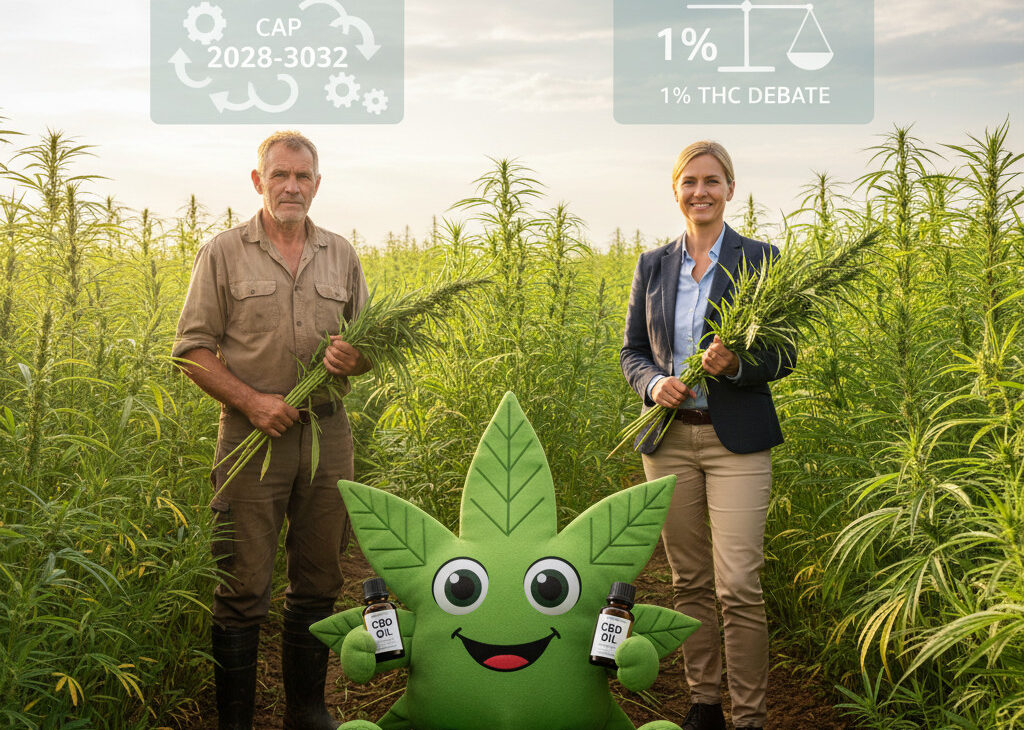
- CAP 2028–2032, CBD production efficiency
- Climate variability, certified seed shortages
Regulatory background: EU hemp THC threshold increase to 1%
The EU has long set strict THC limits for industrial hemp. Historically, member states moved from a 0.5 percent ceiling to a 0.3 percent limit. Because the current 0.3 percent ceiling applies to crops in the field, growers face legal and financial risk when plants exceed that level.
Why regulators are debating a higher THC ceiling
EIHA and other industry stakeholders argue that climate change and agronomy drive higher THC expression. For example, heat and intense sunlight can push plants above legal limits. Therefore, advocates say a 1.0 percent ceiling would reflect agronomic reality and reduce crop loss. Moreover, the European Commission has proposed recognizing the whole hemp plant as an agricultural product. This change aims to remove legal uncertainty for flowers and leaves, however it still needs final approval through CAP negotiations. See the Commission proposal at Commission Proposal and industry commentary at Industry Commentary.
Expected effects on farmers, suppliers, and consumers
For farmers, therefore, a 1 percent threshold would lower the chance of wasted harvests and subsidy penalties. As a result, growers could plan investment in hemp breeding and certified seed. For suppliers, higher legal certainty would ease contracts and scaling in fiber, seed, and CBD markets. Consequently, processors could operate with less regulatory risk, and CBD production may become more efficient because CBD often rises with THC.
International examples and comparisons matter. Some countries already allow a 1.0 percent limit, and reforms elsewhere provide context. For background on New Zealand discussions see New Zealand Discussions.
- EIHA seeks a 1.0 percent THC ceiling to reduce agronomic risk and legal exposure
- The current 0.3 percent limit applies to plants in the field and creates market fragility
- CAP 2028–2032 will define subsidy rules and market oversight
- A realistic threshold could support hemp breeding, certified seed supply, and CBD efficiency
- Policymakers must still balance public health, law enforcement, and market growth
Economic impact of EU hemp THC threshold increase to 1%
Raising the THC ceiling to 1 percent would change the economics of hemp farming in Europe. For starters, farmers could face fewer lost crops and lower compliance costs. Therefore, they could reinvest savings in better seed, mechanization, and sustainable practices. Moreover, processors and manufacturers would gain pricing predictability, which supports long term contracts and investment.
How the change affects product diversity and market growth
A higher threshold would allow breeders to develop varieties with stronger fiber, seed, and cannabinoid profiles. As a result, the hemp product range could expand to include more industrial textiles, food oils, and standardized CBD extracts. Consequently, the hemp market EU may attract new entrants and scale existing operations more quickly.
Industry players and policymakers will watch closely. For context, industry reporting and regulatory analyses highlight both opportunity and risk. See industry commentary at industry commentary and the Commission proposal at Commission proposal for background.
Key economic effects
- Lower risk of crop loss leads to more predictable farm income and higher investment capacity
- Improved seed and varietal development boosts yields for fiber and seed use
- CBD extraction may become more efficient, reducing processing costs
- Market stability encourages vertical integration and new processing facilities
- Potential export opportunities increase if EU rules align with other 1.0 percent jurisdictions
In short, therefore, a 1 percent threshold could unlock scale and diversification. However, regulators must still balance public health, enforcement, and consumer protection to sustain market confidence.
EU hemp THC thresholds over time
| Effective period | THC limit | Notable regulation or amendment | Notes and implications |
|---|---|---|---|
| Historical (varied by member state) | 0.5% | Common national ceilings before EU harmonization | Varied enforcement and agronomic tolerance across countries |
| Current (as of 2026) | 0.3% | Current EU practice applying 0.3% limit to crops in the field | Creates legal and financial risk when heat or sunlight raise THC |
| European Parliament discussion | 0.5% (discussed) | Parliament considered 0.5% as a compromise | Would reduce some risk but may not match agronomic reality |
| Proposed reform under CAP 2028–2032 | 1.0% (proposed) | EIHA advocates 1.0%; Commission proposal recognizes whole plant as agricultural product | Aligns with Czech Republic and Switzerland; reduces crop loss risk and supports CBD efficiency |
Conclusion
A move to an EU hemp THC threshold increase to 1% would deliver clearer rules and tangible benefits for the whole sector. For growers, therefore, the change reduces the risk of wasted harvests, subsidy penalties, and contract disputes. As a result, farmers could invest more in certified seed, breeding, and modern equipment. For suppliers and processors, the higher ceiling improves supply predictability and lowers compliance costs. Consequently, businesses can scale operations and introduce more diverse hemp products with confidence.
Consumers also gain because regulated markets tend to deliver more consistent labeling, quality, and safety. Moreover, CBD manufacturers may see improved extraction efficiency when cannabinoid profiles better match agronomy. MyCBDAdvisor supports readers with clear, evidence driven coverage and full spectrum cannabinoid knowledge. Visit MyCBDAdvisor for updates.
Frequently Asked Questions (FAQs)
What is the EU hemp THC threshold increase to 1% and why is it being considered?
The proposal would raise the legal THC limit for hemp from 0.3 percent to 1.0 percent. Advocates say this change reflects agronomy and climate realities. Heat and sunlight can raise THC in the field. Therefore, a 1 percent ceiling would reduce crop losses and legal risk for growers.
How does a higher THC limit affect the legality of hemp products?
Hemp that tests at or below the legal THC ceiling remains non controlled. However, therefore, strict testing and chain of custody rules remain essential. As a result, processors must continue lab testing and record keeping to prove product compliance.
Will consumer safety and product quality change if limits rise?
Consumer safety should not suffer because regulation would still require testing. Moreover, including hemp in EU marketing standards would improve labeling and transparency. Consequently, buyers would get clearer potency and origin information.
How will farming practices and risk management change for growers?
Farmers could adopt different seed lines and improved breeding. In addition, they might reduce crop destruction risk during heat waves. As a result, growers can plan plant density, monitoring, and harvest timing more confidently.
What does this mean for the hemp market and businesses in the EU?
The change could expand product diversity and scale industry growth. For example, fiber and CBD product lines may become more viable. Therefore, the hemp market EU could attract new investment and improve export potential. However, policymakers must balance growth with enforcement and consumer protection.