The Cannabis consumers firearms ban in Supreme Court case Hemani has thrust a major constitutional conflict into the national spotlight, forcing courts to confront how federal drug laws intersect with Second Amendment rights. At issue is whether the government may categorically disarm people who use cannabis, even if states authorize medical or recreational use, and whether historical tradition supports such a broad federal prohibition.
Amici briefs from organizations including the NRA, NORML, the Independence Institute, and the FPC Action Foundation sharpen the debate by offering competing histories, public safety studies, and constitutional arguments that the Court must weigh. A ruling for Hemani could restore firearm rights for many state lawful users, while an adverse decision could validate sweeping federal limits that apply regardless of state law, creating major practical and legal consequences.
This introduction previews the legal stakes, summarizes the central briefs, and outlines what a decision could mean for cannabis consumers, gun owners, and policymakers across the country.
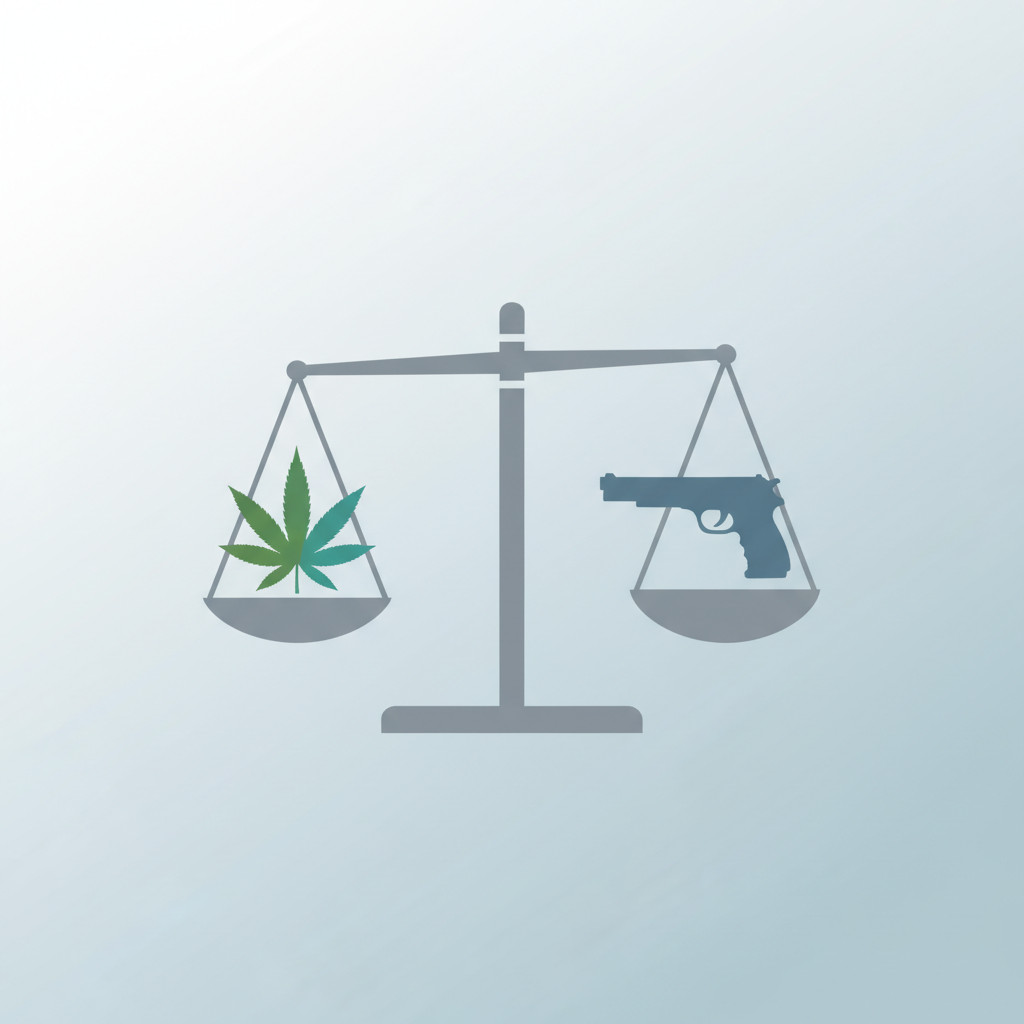
Background: Cannabis consumers firearms ban in Supreme Court case Hemani
The federal prohibition that lies at the heart of this dispute traces to 18 U.S.C. 922(g)(3). Congress added the provision in the Gun Control Act of 1968 to bar firearm possession by unlawful users of or people addicted to controlled substances. Because of that rule, many people who use cannabis face a federal firearms restriction even where state law permits use. For a statutory text reference see 18 U.S.C. 922(g)(3).
Federal cannabis policy adds a second layer of conflict. The Controlled Substances Act still lists cannabis as a Schedule I drug. However many states now legalize medical or adult use cannabis. As a result state law and federal law often clash on possession, commerce, and related civil rights. NORML has argued that centuries of cannabis use in America did not historically justify loss of gun rights. For more context see NORML’s analysis on adult-use legalization and the National Institute of Justice study on crime in Colorado and Washington at NIJ’s cannabis effect study.
Recent court rulings heightened the debate. Lower courts and courts of appeals have split on whether 922(g)(3) passes constitutional scrutiny as applied to cannabis users. The Fifth Circuit and other panels considered historical tradition and public safety data when they weighed the law. Moreover advocacy groups filed amicus briefs in United States v. Hemani. The NRA, NORML, the Independence Institute, and the FPC Action Foundation pressed competing histories and policy studies before the Supreme Court. See the NRA brief at NRA’s amicus brief and a statement on appellate rulings at FPC’s statement.
Key regulatory milestones and legal challenges
- 1968 Gun Control Act creates modern federal firearms framework and 922(g)
- 1970 Controlled Substances Act classifies cannabis as Schedule I
- 1996 onward states begin legalizing medical cannabis and later adult use
- Recent appeals rulings question 922(g)(3) as applied to marijuana users
- Amicus briefs in United States v. Hemani present competing historical arguments
Together these developments show why the Supreme Court case matters. Therefore the outcome will influence gun rights, state cannabis regimes, and future firearms restrictions under federal law.
State level comparison: Cannabis consumers firearms ban in Supreme Court case Hemani
| State or Forum | Cannabis Legal Status | Firearms Restrictions | Relevant Court Cases and Links |
|---|---|---|---|
| Federal Supreme Court | Cannabis is Schedule I under federal law | 18 U.S.C. 922(g)(3) bars firearm possession by unlawful users of controlled substances | United States v. Hemani (Supreme Court docket) |
| California | Adult use legal statewide since 2016 | No state-level disarmament of cannabis consumers; federal 922(g)(3) still applies | Hemani coverage and analysis |
| Colorado | Adult use legal since 2012 | No additional state ban; federal restrictions remain | National Institute of Justice time series study on cannabis and crime |
| Texas | Adult use not legal; limited medical and hemp programs | State criminalization persists in many cases; federal 922(g)(3) applies | Hemani originated from Texas and reached the Supreme Court |
| New York | Adult use legalized in 2021 | State permits adult use but does not override federal firearm prohibitions | Federal challenges and Hemani implications discussed by civil liberties groups |
| Florida | Medical program in place; adult use not legal | No explicit state disarmament of medical users; federal law governs firearm possession | Fifth Circuit and related appellate rulings analyzed by firearms law scholars |
This table highlights variance between state cannabis legal status and the persistent federal firearm prohibition under 18 U.S.C. 922(g)(3).
The Supreme Court case Hemani could change how 922(g)(3) applies to cannabis consumers nationwide.
See the official docket for Hemani for filings and amicus briefs here.
Implications: Cannabis consumers firearms ban in Supreme Court case Hemani
The Supreme Court’s decision in Hemani will shape legal impact on firearms law and cannabis consumer rights. First, the Court could narrow or strike down 18 U.S.C. 922(g)(3) as applied to cannabis users. For statutory text see the legal text. If the Court rules for Hemani, many state lawful cannabis consumers may regain firearm rights. Moreover federal prosecutions relying on 922(g)(3) could decline, and background check forms could change.
However the Court might uphold the statute broadly. In that case the federal firearms ban would stand despite state legalization. Consequently cannabis consumers would remain subject to a categorical firearms ban under federal law. As a result medical patients and recreational users could face persistent civil and criminal risks.
Beyond the binary outcome, mixed or as-applied rulings are possible. The Court could limit 922(g)(3) to users who are demonstrably impaired. In contrast the ruling might preserve restrictions for users adjudged dangerous. Therefore legal uncertainty could remain for months or years.
Social and consumer impacts will vary. Public safety studies matter in the debate. For example a National Institute of Justice analysis found minimal long-term crime effects after legalization in Colorado and Washington here. Meanwhile advocates argue historical tradition supports or opposes blanket disarmament. See NORML’s historical argument at this analysis.
Possible downstream effects include congressional action to revise 922(g)(3), state-level legal reforms, and litigation over past convictions. Consumer rights advocates will likely press for restoration of gun rights for state-legal users. Conversely public safety groups may push for narrowly tailored limits.
Ultimately the Hemani decision will redraw the legal map. Therefore stakeholders should watch for changes to firearms ban doctrine, consumer rights protections, and legislative responses nationwide.
Conclusion
The Cannabis consumers firearms ban in Supreme Court case Hemani crystallizes a clash between federal drug policy and constitutional gun rights. The Court’s decision will decide whether 18 U.S.C. 922(g)(3) remains a categorical firearms ban for cannabis users, or whether courts must limit that rule as applied. Because of that choice, millions of state lawful users and medical patients face uncertain outcomes. Moreover the ruling could prompt new litigation, changes to background check practices, and congressional responses.
MyCBDAdvisor will continue to track developments. As a comprehensive research driven source on CBD hemp and cannabinoids, it offers analysis, citations, and plain language summaries for consumers and advocates. Therefore readers can rely on it for updates and context as the case unfolds.
Frequently Asked Questions (FAQs)
What is the Cannabis consumers firearms ban in Supreme Court case Hemani about?
The case asks whether 18 U.S.C. 922(g)(3) can bar firearm ownership for cannabis users. For the statute text see statute text. The Supreme Court will weigh history, safety data, and constitutional rights. See the Court docket at Court docket.
Could a ruling for Hemani restore gun rights for cannabis consumers?
Yes possibly. If the Court limits or strikes down 922(g)(3) as applied to marijuana users, many state lawful users could regain firearm rights. However Congress or lower courts might still impose narrower rules.
Will a pro Hemani decision change state cannabis rules?
Not directly. State cannabis legal status would remain separate. Yet a decision could remove federal barriers. Therefore state lawful users may face fewer federal conflicts.
Does research show legalization harms public safety?
Major analyses find mixed effects. For example a National Institute of Justice study found minimal long term crime changes in Colorado and Washington study link. Meanwhile advocates cite history and data to support their claims. See NORML’s analysis at NORML’s analysis.
What should cannabis consumers do now?
First consult legal counsel if you own firearms and use cannabis. Second follow case updates and avoid federal law violations. Finally consider advocacy and education to protect consumer rights.