
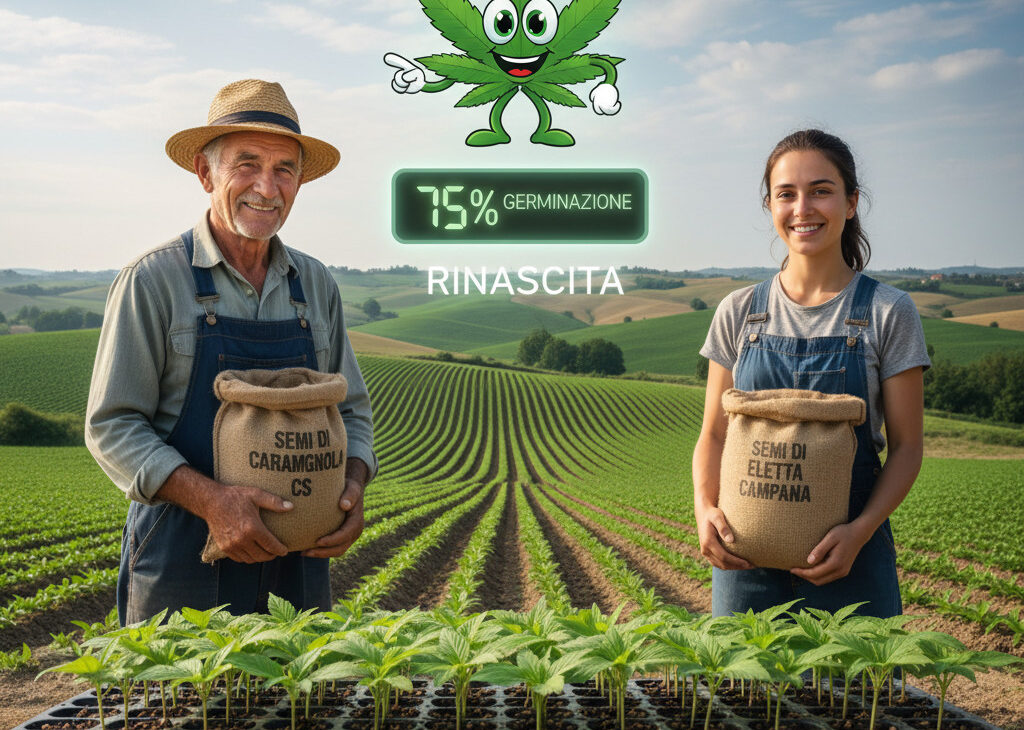
Italian heritage hemp germination reaches EU 75% standard in 2025
Italian heritage hemp germination reaches EU 75% standard in 2025, marking a pivotal return for growers and exporters across Europe. Furthermore, this milestone proves that historic varieties like Carmagnola Selezionata, Eletta Campana, and Fibranova now meet strict EU seed-marketing rules. For years producers faced rumors of low germination. New 2025 seed production data from Canapa Industriale dispel those doubts. As a result, planting predictability, contracts, financing, and export opportunities can all improve for farmers and seed companies.
Monferrato breeders and Piedmont seed producers refined selection and breeding practices for decades. Their work now delivers measurable gains. Therefore, farmers can plan crops with greater confidence because seed performance aligns with legal compliance and market demand. Assocanapa echoed this shift, stating that the old prejudice about poor germination is now a thing of the past. This introduction previews deeper insight into how improved genetics and controlled breeding drove the change. It also outlines how better production practices could reshape fiber yields, grain yields, and the European hemp market.
Why Germination Standards Matter: Italian heritage hemp germination reaches EU 75% standard in 2025
Good seed germination rates set the baseline for reliable crops. Because germination drives stand establishment, it directly affects yield, fiber quality, and grain output. EU seed marketing rules require a minimum 75% germination for industrial hemp, making compliance essential for legal sales and cross border trade here.
Official 2025 seed production data show Carmagnola, Carmagnola Selezionata, Eletta Campana, and Fibranova well above the 75% threshold. This breakthrough is documented by Canapa Industriale and reported by HempToday, which note the Monferrato supply chain as a driving force. As a result, Assocanapa declared that the old prejudice about low germination is now a thing of the past here.
Key benefits and impacts:
- Planting predictability improves because more seeds reach emergence, so farmers plan acreage and inputs with confidence.
- Contract reliability increases, therefore buyers honor supply agreements and processors trust delivery.
- Financing and insurance options expand, thus banks and lenders see lower agronomic risk.
- Export opportunities grow because certified seed meets EU marketing rules and phytosanitary checks.
- Seed value and breeding incentives rise, as breeders invest in proprietary programs to enhance genetics.
Better germination supports higher fiber yields and stable grain yields, and it restores market faith in Italian heritage varieties. Moreover, controlled breeding and decades of selection in Piedmont prove that tradition and modern seed science can align to meet EU standards.

Italian heritage hemp germination reaches EU 75% standard in 2025
The phrase Italian heritage hemp refers to historic varieties nurtured for centuries in Italy. These varieties include Carmagnola, Carmagnola Selezionata CS, Eletta Campana, and Fibranova. For decades they earned praise for fiber quality and adaptability. However, they also carried a reputation for poor germination. Today that reputation no longer fits the facts.
Local seed producers in Monferrato and Piedmont combined traditional knowledge with modern seed science. They selected the best mother plants and used controlled breeding to boost seed vigor. As a result, official 2025 seed production data show germination well above the EU minimum 75 percent. Canapa Industriale recorded these results and reported the improvement here.
Scientists and agronomists ran systematic field trials, seed cleaning, and lab germination testing to ensure reliable outcomes. Furthermore, industry reporting amplified the progress, including coverage by HempToday here. Assocanapa reinforced the message that the old prejudice about low germination is now a thing of the past here.
Key elements of the breakthrough include:
- Decades of selection that preserved desirable traits and improved seed uniformity
- Controlled breeding programs that increased seed vigor and emergence rates
- Rigorous quality control and lab testing before seed marketing
- Close grower breeder collaboration to scale improvements across fields
Together tradition and science restored legal compliance and market trust. Therefore farmers gain predictable stands, and processors benefit from consistent seed lots. This shift strengthens exports, contracts, and financing across the European hemp market.
Comparison of germination standards across Europe
The table below compares germination standards across key EU producers. It shows how Italy’s heritage hemp germination reaching the EU 75% standard in 2025 fits the broader picture.
| Country | Germination Standard % | Progress to 2025 | Notes |
|---|---|---|---|
| Italy | 75% (EU minimum) | Historic low now above 75% in 2025 | Canapa Industriale reported varieties now exceed the threshold; Monferrato breeding drove gains |
| France | 75% (EU minimum) | Consistently meets standard | Longstanding breeding programs and commercial seed production strengthen compliance |
| Germany | 75% (EU minimum) | Consistently meets standard | Robust seed certification and laboratory testing ensure reliable germination figures |
| Netherlands | 75% (EU minimum) | Consistently meets standard | High quality seed production supports fiber and grain markets |
| Spain | 75% (EU minimum) | Mostly meets standard | Regional producers increasingly align with EU marketing rules and testing |
| Poland | 75% (EU minimum) | Mostly meets standard | Growing seed sector with improving quality control and lab testing |
CONCLUSION
Italian heritage hemp germination reaches EU 75% standard in 2025 marks a turning point for growers and markets. This achievement restores confidence in historic varieties and verifies that tradition can meet modern regulation. As a result, farmers gain predictable stands and processors receive more consistent raw material.
The impact extends beyond immediate sales. Because germination improved, contracts become more reliable and financing becomes easier to secure. Moreover, higher and steadier germination supports better fiber quality and more consistent grain yields. Therefore sustainability improves through reduced reseeding and lower input waste.
Frequently Asked Questions (FAQs)
What does Italian heritage hemp germination reaching the EU 75% standard in 2025 mean?
It means historic Italian hemp varieties now meet the EU minimum germination threshold. This proves seed quality improved. As a result growers can trust stand establishment and plan with more certainty.
Which Italian varieties achieved these germination gains?
Official 2025 seed data show Carmagnola, Carmagnola Selezionata CS, Eletta Campana, and Fibranova well above 75 percent. For verification see Canapa Industriale and industry coverage at HempToday.
How does higher germination affect growers and the hemp industry?
Higher germination improves planting predictability. Therefore farmers need fewer reseeds and lower input waste. Contracts become more reliable, which helps processors and buyers. Moreover lenders see less risk, so financing and insurance options expand.
Is meeting the 75 percent standard required for legal seed marketing and exports?
Yes. EU seed marketing rules mandate a minimum 75 percent germination for industrial hemp. Consequently certified seed that meets this rule can cross borders under EU marketing requirements. Read the regulation at EU Marketing Requirements.
What drove the improvement in germination rates?
Decades of local selection in Monferrato and Piedmont formed the foundation. Then controlled breeding, strict seed cleaning, and lab testing raised seed vigor. Additionally grower breeder collaboration scaled improvements across fields. Assocanapa confirms that the old prejudice about low germination is now outdated Assocanapa.