The Eleusinian Mysteries and psychedelics in Ancient Greece have long fascinated scholars and seekers. Shrouded in incense, myths, and strict secrecy, the rites promised a passage into altered perception. Initiates descended into dim halls at Eleusis to confront mythic death and rebirth. Because the ceremonies remained secret, they bred myth and modern mystery.
Archaeologists recovered cups, cryptic reliefs, and literary fragments. However, the material record rarely names the key ingredients. Recent experiments and chemical analyses suggest a surprising possibility. Specifically, researchers have tested whether ergot and other botanicals could have made kykeon psychoactive.
This article explores that evidence with care and skepticism. Therefore, we will examine ancient sources, experimental archaeology, and modern pharmacology. We aim to separate what the evidence supports from what legend inflates. Along the way, readers will gain a clearer picture of ritual, science, and human longing.
By tracing fragile clues, we invite readers to weigh evidence, not to claim certainty. Ultimately, the story of Eleusis opens a window onto ancient religion and the human search for meaning.
Exploring the Eleusinian Mysteries and psychedelics in Ancient Greece
Subheading: Eleusinian Mysteries and psychedelics in Ancient Greece
The Eleusinian Mysteries grew from the small town of Eleusis into a panhellenic rite. Initiates honored Demeter and Persephone. The rituals promised a profound encounter with life, death, and renewal. Because participants kept a strict vow of secrecy, only fragments reached later writers.
Archaeology and ancient texts provide a partial picture. Together they show sacred processions, purification rites, fasting, and a culminating revelation. However, the most debated element is kykeon, the sacred brew. Some scholars propose it contained psychoactive ingredients that helped produce visionary states. Recent experimental archaeology and chemical analysis support this possibility. For experimental results, see the Scientific Reports study. For cultural background, see an accessible overview at World History article and a reference summary at Encyclopedia.com.
Key aspects and significance
- Durability: The Mysteries ran for nearly two thousand years and shaped Greek religious life.
- Inclusivity: Men, women, and many social classes could join the rite.
- Mythic frame: The story of Persephone structured the ritual meaning.
- Kykeon centrality: The barley and mint brew may have contained other botanicals.
- Psychoactive candidates: Scholars discuss ergot, psilocybin, Amanita muscaria, and DMT.
- Social effect: The rite offered consolation about death and communal identity.
Related keywords and semantic terms include kykeon, ergot, Claviceps purpurea, LSA, iso-LSA, LSD, Demeter, Persephone, and psychedelic Eleusis. In the next sections we will evaluate the evidence. Therefore, readers can weigh the archaeological, textual, and chemical data.
Theories and Evidence Surrounding Psychedelic Use in the Eleusinian Mysteries
Subheading: Eleusinian Mysteries and psychedelics in Ancient Greece Evidence and theories
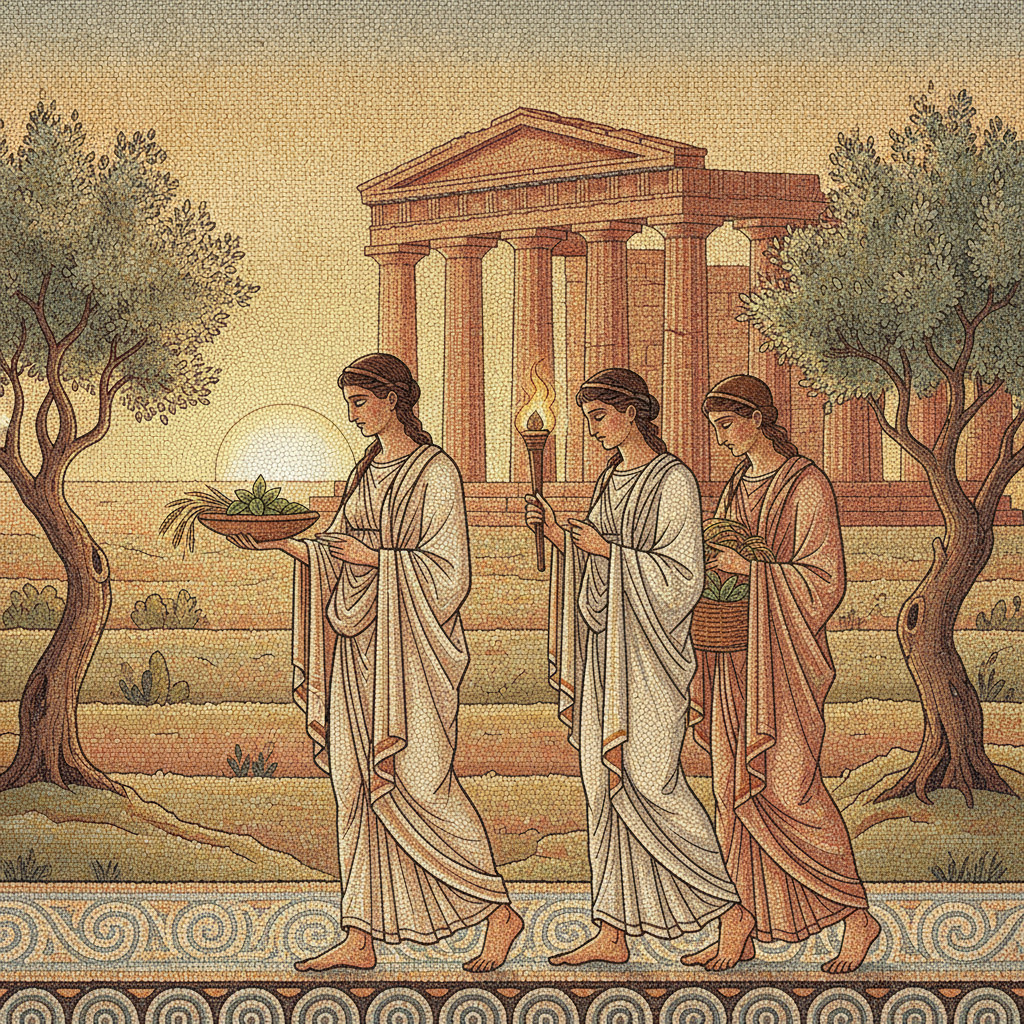
Scholars propose multiple lines of evidence that link the Mysteries to altered states. First, ancient texts record kykeon as a sacred barley-based drink. Because authors describe profound transformation among initiates, some argue the drink induced visionary experiences. However, the texts never name a psychoactive ingredient.
Archaeological evidence complements the textual record. Archaeologists found cups, mixing vessels, and sanctuary deposits at Eleusis. Moreover, pottery and reliefs show ritual dining and processions. Therefore, material culture confirms communal consumption and a powerful ritual context.
Experimental chemistry provides the most direct support for the psychedelic hypothesis. A recent study demonstrated that processed ergot could yield lysergic acid amide LSA and isolysergic acid amide iso-LSA under conditions plausible for ancient practice. The team used grinding, alkaline boiling, nuclear magnetic resonance, and high-resolution mass spectrometry. See the published paper at this study and an accessible report at this report for media coverage.
Notable scholarly voices
- Prokopios Magiatis and Romanos K. Antonopoulos: Lead authors of the experimental study who argue the chemistry is feasible.
- Carl A. P. Ruck: A classicist who has long promoted entheogenic readings of ancient religion.
- Mark A. Hoffman: A chemist who provided analytical perspective in the collaborative research.
Evidence summary
- Textual clues: References to kykeon and secret revelations imply altered perception.
- Material finds: Vessels and ritual spaces support communal ingestion.
- Chemical plausibility: Experimental archaeology shows ergot processing could produce psychoactives.
Caveats and counterpoints
- Ergotism risks: Ergot can cause severe poisoning and mass illness because of ergopeptides.
- Alternative candidates: Psilocybin, Amanita muscaria, DMT, and opium remain possible.
- Historical gap: Direct proof of deliberate psychedelic use remains elusive.
Together, these strands make the psychedelic Eleusis hypothesis credible but not conclusive. Therefore, readers should weigh chemical feasibility alongside archaeological and textual limits when considering this provocative theory.
Comparative table of substances theorized in the Eleusinian Mysteries
Below is a concise comparison of substances proposed as components of kykeon or related ritual agents. Each entry notes source, psychoactive qualities, historical evidence, and possible cultural role.
| Substance Name | Source | Psychoactive Properties | Historical Evidence | Cultural Role |
|---|---|---|---|---|
| Ergot (Claviceps purpurea) | Parasitic fungus on cereals, especially barley | Contains ergopeptides and precursors to LSA and iso-LSA. Can cause hallucinations and strong vasoconstriction | Experimental archaeology shows ergot processing can yield LSA compounds. Texts mention kykeon but not ingredients | Strong candidate for a kykeon additive because barley was central to the brew |
| Psilocybin mushrooms (Psilocybe) | Wild fungi growing on wood and dung | Psilocybin produces visual alterations and emotional shifts | No direct archaeological finds at Eleusis. Theory rests on comparative ritual use elsewhere | Plausible as a visionary agent, but evidence in Greece is circumstantial |
| Amanita muscaria | Fly agaric mushroom found under trees | Muscimol causes delirium, vivid visions, and dissociation | Limited textual or material evidence in Greek ritual contexts | Known in Eurasian shamanic traditions; speculative for Eleusis |
| LSA containing plants or seeds | Various plants with ergoline alkaloids, historically proposed candidates | LSA produces mild to moderate psychedelic effects similar to LSD | Chemical plausibility discussed in scholarship, though specific Greek species are debated | Suggested as an alternative source of lysergic effects within kykeon |
| Opium (Papaver somniferum) | Poppy latex | Sedation, analgesia, and euphoria rather than classic psychedelia | Well documented in ancient Mediterranean material and texts | Used medicinally and possibly ritually; may have eased rites but not caused visions |
| DMT containing plants | Various shrubs and trees bearing DMT | Potent, short-acting visionary experiences when active orally with MAOI | No direct evidence for their use in classical Greece | Conceptually possible but historically unlikely without MAOI preparations |
Related keywords and semantic terms include kykeon, LSA, iso-LSA, ergot, Claviceps purpurea, psilocybin, Amanita muscaria, opium, and DMT. Therefore, the table highlights plausibility and limits. Use it to compare theories, because each claim mixes material clues with scholarly inference.
CONCLUSION
The Eleusinian Mysteries remain one of history’s most compelling rituals. They combined myth, community, and a promise of renewal. Evidence now suggests kykeon might have included psychoactive elements. Therefore, archaeology, chemistry, and texts together make a persuasive case. However, direct proof still eludes us.
Understanding these rites matters because they reveal how ancient people sought meaning. Rituals such as Eleusis helped communities face death and celebrate life. Moreover, the possibility of ergot, LSA, or other botanicals links ritual practice to embodied experience. As a result, we gain insight into ancient spirituality and human cognition.
Modern research echoes these questions. Scientists test hypotheses with chemical analysis and experimental archaeology. Yet scholars warn against simple conclusions. Alternative candidates and risks like ergotism remain relevant. Consequently, balanced interpretation is essential.
Frequently Asked Questions (FAQs)
What were the Eleusinian Mysteries?
The Eleusinian Mysteries were ancient initiation rites centered on Demeter and Persephone. They took place near Athens for nearly two thousand years. Initiates underwent purification, procession, and a secret culminating rite. Therefore, the Mysteries shaped Greek religious life and offered a hopeful view of death and renewal.
Did kykeon include psychedelics?
Scholars debate whether kykeon contained psychoactive ingredients. Recent experimental work supports the idea that processed ergot could yield LSA compounds. However, ancient texts never list a named visionary plant. Thus, kykeon might have been psychoactive, but direct proof remains absent.
What evidence supports the psychedelic hypothesis?
Evidence combines ancient writings, archaeological finds, and chemical experiments. Writers describe a powerful communal experience after drinking kykeon. Archaeologists found mixing vessels and ritual spaces at Eleusis. Experimental archaeology shows ergot processing can produce LSA and iso-LSA. As a result, the chemical data strengthen the hypothesis.
Which substances have scholars proposed?
Researchers propose ergot, psilocybin mushrooms, Amanita muscaria, opium, and DMT-bearing plants. Each candidate has strengths and limits. For example, ergot aligns with barley-based kykeon but carries poisoning risks. Therefore, scholars remain cautious and consider multiple possibilities.
Why does this topic matter today?
Studying the Eleusinian Mysteries and psychedelics in Ancient Greece helps us trace ritual uses of mind-altering substances. It shows how rituals shaped belief and social bonds. Consequently, these insights inform modern conversations about entheogens, therapy, and cultural context.