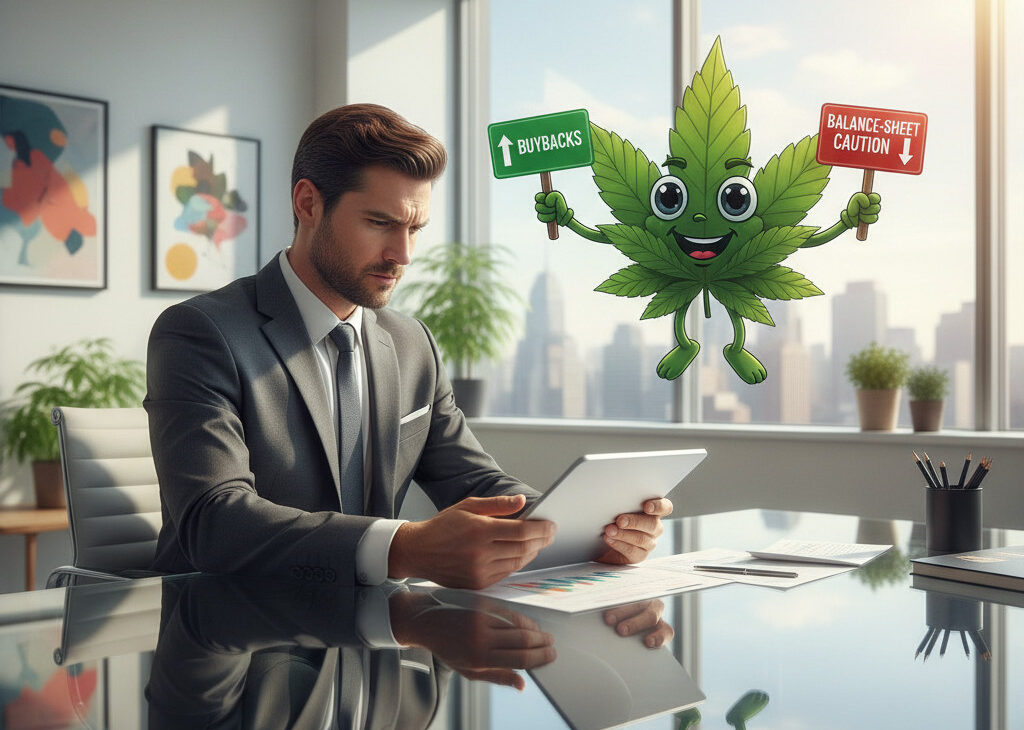
Share Repurchases in Cannabis Companies
Share repurchases in cannabis companies are gaining attention as firms return cash to shareholders through buybacks. Investors watch these moves closely because buybacks can signal confidence about valuation and future cash flow. However, repurchases can also mask balance sheet weaknesses when companies carry debt or negative tangible book value. This introduction explains what buybacks mean and why they matter for cannabis investors.
A share repurchase occurs when a company buys its own shares from the market. As a result, available shares shrink and earnings per share can rise even if profits stay flat. In the cannabis sector, low valuations make repurchases tempting, especially when firms report net cash or face pressure on adjusted EBITDA. Yet, investors should be cautious. For example, buybacks funded by debt can increase financial risk. Therefore, weigh the tradeoffs between valuation support and long term balance sheet strength. This article guides investors through that analysis with clear examples and practical checkpoints.

How Share repurchases in cannabis companies work
Share repurchases in cannabis companies occur when a firm buys its own shares to reduce outstanding float. Companies typically use open market purchases or tender offers to complete buybacks. For a clear primer on how buybacks work, see Charles Schwab for investors: Charles Schwab.
Open market repurchases happen over time. Meanwhile, tender offers let shareholders sell a set number of shares at a fixed price. Management may also use accelerated share repurchases or privately negotiated repurchases in special cases.
Motivations in the cannabis sector differ from traditional industries. For example, low valuations make buybacks attractive because they can boost per share metrics without improving operations. Also, companies with net cash may return capital to shareholders. However, firms with negative tangible book value or high debt risk harming long-term solvency when they repurchase stock.
Because of regulatory scrutiny and disclosure rules, firms must report buybacks clearly. For recent SEC guidance and disclosure expectations, see CNBC. Moreover, several cannabis companies have announced buybacks; see a recent example: Auxly Cannabis Group.
Benefits
- Supports valuation when shares trade below intrinsic value. This can increase shareholders upside.
- Raises earnings per share because the share count falls.
- Returns excess cash to investors instead of holding idle capital.
Risks
- May worsen leverage if funded with debt. Consequently, insolvency risk can rise.
- Can mask weak operating performance by boosting per share metrics.
- May signal short term management interest in inflating stock metrics rather than investing in growth.
Investors should examine cash on hand, tangible book value, and debt before treating buybacks as a positive. Therefore, weigh the tradeoffs between valuation support and balance sheet strength.
| Company Name | Repurchase Program Size | Repurchase Frequency | Year Implemented | Impact on Stock Price |
|---|---|---|---|---|
| Green Thumb Industries (GTI) | Active open market repurchases disclosed in filings. | Ongoing open market purchases across recent quarters. | Ongoing; increased in latest quarters. | Short term valuation support and EPS lift; limited long term evidence. |
| Cronos Group | Opportunistic purchases executed in November and December near tangible book value. | Sporadic opportunistic buys. | Late 2025 (most recent activity). | Provided modest price support around purchases; sustained impact unclear. |
| Trulieve | No reported repurchase program. | None reported. | N/A | No buyback driven support. |
| Ascend Wellness Holdings | No repurchases disclosed; company faces negative tangible book value and operational headwinds. | None reported. | N/A | Shares pressured by negative tangible book value and a recent penalty; no buybacks reported. |
Impact of Share repurchases in cannabis companies on valuation and investor perception
Share repurchases can change how investors value cannabis firms. Because buybacks reduce share count, earnings per share often rise even without profit growth. As a result, markets may treat repurchases as a sign of confidence.
For example, Green Thumb Industries increased open market repurchases this year. See the company notice here: Green Thumb Industries Notice. Similarly, Cronos Group executed opportunistic buys in November and December near tangible book value. Learn more at Cronos Group. These actions provided short term support to stock momentum. However, the sustainability of that support varied across issuers.
By contrast, Trulieve did not report repurchases. Investors therefore judged the company on operations alone. See Trulieve disclosures at Trulieve Disclosures. Meanwhile, Ascend faces negative tangible book value and other headwinds that limit buyback appeal. More on Ascend at Ascend.
How repurchases affect valuation
- They lift per share metrics because the denominator falls. Consequently, price to earnings ratios can compress.
- They signal management confidence when funded with excess cash. Therefore, investors may reprice shares higher.
- They can hurt valuation if companies fund buybacks with debt. As a result, credit risk can rise and shares may trade lower.
Investor takeaways
- Check cash on hand and tangible book value before praising buybacks.
- Favor repurchases funded from excess cash, not from new debt.
- Watch timing. Opportunistic buys near tangible book value look more conservative.
Overall, repurchases can support short term shareholder value. However, in a risky sector like cannabis, prioritize balance sheet strength.
Share Repurchases and Their Impact on Cannabis Firms
Share repurchases can support short term shareholder value, but they do not substitute for strong fundamentals. However, when cannabis firms fund buybacks with cash and buy at low valuations, repurchases can help. They become a pragmatic use of capital.
Conversely, buybacks financed with debt or by companies with negative tangible book value can raise financial risk. They can hurt long term returns. Therefore, investors should weigh cash on hand, debt levels, and timing before rewarding buyback announcements.
MyCBDAdvisor serves as a full spectrum, research driven CBD knowledge source that delivers reliable, transparent cannabinoid information and market analysis. Visit MyCBDAdvisor for deeper guides and data. Moreover, our coverage includes emerging themes such as share repurchases in cannabis companies, with practical checklists.
Frequently Asked Questions (FAQs)
What are share repurchases in cannabis companies?
Share repurchases occur when a cannabis firm buys its own shares. This reduces outstanding shares and raises earnings per share. Companies do this to return excess cash or to signal confidence in valuation.
Why do cannabis companies announce buybacks?
Firms use buybacks for several reasons. First, low valuations can make repurchases attractive. For example, Green Thumb Industries increased open market buybacks this year here. Second, some issuers make opportunistic purchases, as Cronos Group did in late 2025 here. Third, buybacks can be a way to allocate excess cash instead of investing it.
Are buybacks good for investors?
They can help, but be cautious. Benefits include short term valuation support and higher per share metrics. However, risks exist. Buybacks financed with debt can raise leverage. Also, repurchases can mask weak operating performance. Therefore, treat buybacks as part of a wider company assessment.
How should investors evaluate a repurchase program?
Look for clear signs that management is acting prudently. Check these items:
- Cash on hand and free cash flow. Favor buybacks funded from cash, not new debt.
- Tangible book value and balance sheet health. Companies with negative tangible book carry more risk.
- Timing and price. Opportunistic buys near tangible book value appear more conservative.
- Disclosure and governance. See SEC and disclosure guidance for clarity, for example here.
Can repurchases hurt a cannabis company?
Yes. If a company uses scarce cash or borrows to buy stock, it can weaken operations. For example, companies with negative tangible book value or recent penalties face higher risk. Trulieve reported no buybacks, leaving investors to focus on operations here. As a result, repurchases must be judged against balance sheet strength and long term strategy.