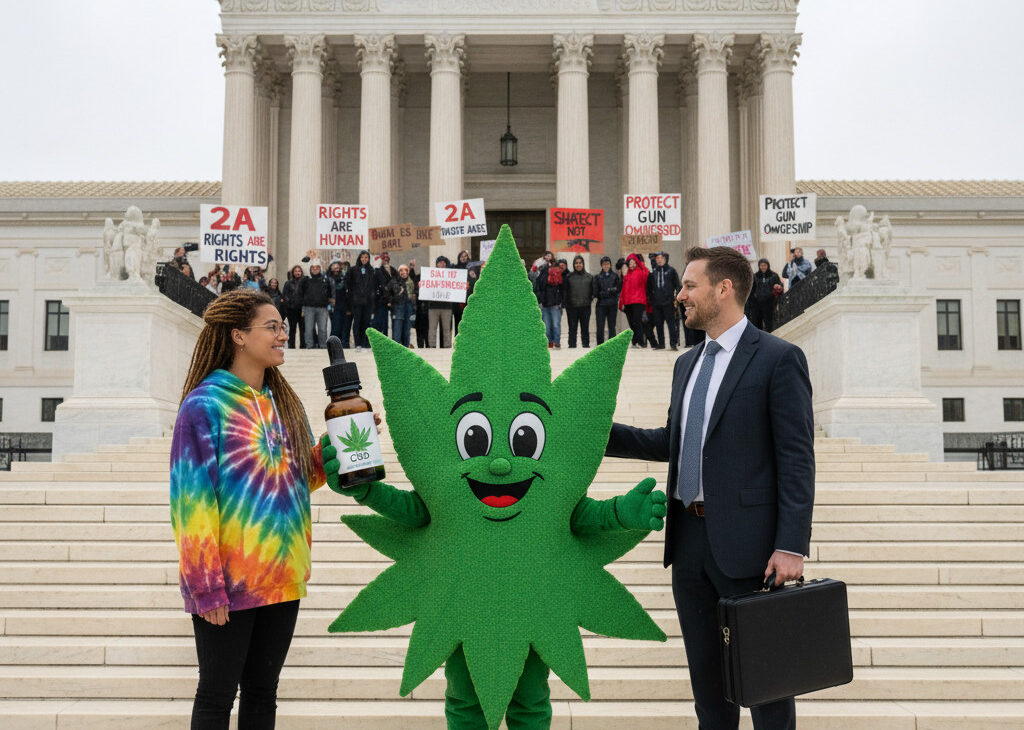
Supreme Court firearms ban for cannabis consumers: Navigating the legal storm
The Supreme Court firearms ban for cannabis consumers now sits at the center of a heated legal battle. The issue blends Second Amendment rights and federal drug policy. As a result, courts face novel questions about historical precedent and modern enforcement. This introduction hooks the controversy and previews a research-driven, neutral analysis.
Why readers should care
- Millions could see changes to gun ownership rules
- The case tests how the Second Amendment applies to substance use
- Courts will weigh historical analogies, such as laws on habitual drunkards
- Regulators and civil rights groups may face new enforcement challenges
What this article will do
First, we break down the legal arguments raised at the Supreme Court. Then, we summarize relevant case law and key judicial comments, including those by Amy Coney Barrett, Neil Gorsuch, and John Roberts. Next, we assess possible outcomes and their implications for cannabis consumers and law enforcement. Finally, we suggest practical steps for affected residents and policymakers.
Overall, the article aims to be clear, neutral, and evidence-based. Therefore, readers will get plain explanations, legal context, and reliable sources.
Supreme Court firearms ban for cannabis consumers: legal background
Federal law makes the core rule clear. Under 18 U.S.C. Section 922(g)(3), the government bars firearm possession by anyone who is an unlawful user of a controlled substance. Because federal law still lists cannabis as a controlled substance, the rule applies even in states that allow marijuana. Therefore, many adults who legally use cannabis under state law remain disqualified under federal gun rules.
The Hemani case tests that rule directly. In 2026 the Supreme Court took up a challenge after the 5th Circuit overturned charges against Ali Daniel Hemani. The lower court found the federal ban could violate the Second Amendment in light of the Supreme Court’s 2022 decision in New York State Rifle & Pistol Association v. Bruen. For background on the federal statute, see 18 U.S.C. Section 922. For the 2022 Bruen ruling, see New York State Rifle & Pistol Association v. Bruen.
The Supreme Court now decides how constitutional analysis should proceed. Under Bruen, courts ask whether a modern regulation fits within the Nation’s historical tradition of firearm regulation. As a result, justices debated analogies to historical “habitual drunkard” laws. For instance, Justice Barrett questioned whether similar precedents could support the ban. Meanwhile, Chief Justice Roberts warned that a broad ruling might let defendants challenge prosecutions on a drug-by-drug basis.
In short, the Court must reconcile statutory text, historical practice, and modern public safety concerns. Consequently, the outcome will shape both gun rights and federal enforcement against cannabis consumers.
| State | Cannabis legal status | Firearm restrictions for cannabis users | Notes on enforcement or exceptions |
|---|---|---|---|
| California | Recreational legal | Federal 18 U.S.C. 922(g)(3) bars firearm possession by unlawful users. State offers no federal exemption. | State does not override federal law. For case context see this link. |
| Colorado | Recreational legal | Federal ban applies. State law does not create a firearm exception for users. | Enforcement typically follows federal guidance. See overview this link. |
| Illinois | Recreational legal | Federal ban applies. No state-level firearm exemption for cannabis users. | Medical registries may impact records. Check state agency guidance. |
| Florida | Medical only | Federal ban applies. Medical use does not erase federal disqualification. | Patients may face conflicts between state and federal rules. See discussion here. |
| Texas | Medical limited | Federal ban applies across the state. No state exemption exists. | Texas prosecutions can involve both state and federal actors. |
| New York | Recreational legal | Federal ban applies. State law lacks a firearm exemption for users. | State enforcement aligns with federal law and practice. |
| Idaho | Illegal | Cannabis illegal. Users risk state and federal consequences for firearms possession. | State penalties can compound federal charges. |
| Washington | Recreational legal | Federal ban applies. No state-level firearm exception exists. | Local agencies follow federal guidance for prosecutions. |
Notes: This table is a quick reference. For exact, current legal advice consult an attorney or state agencies.
Arguments For and Against the Supreme Court firearms ban for cannabis consumers
The debate divides along public safety and constitutional lines. Supporters emphasize risk and prevention. Opponents stress rights and fairness. Below we explain the core arguments on both sides in plain language.
Arguments For the ban
- Public safety concerns. The government says drug use can impair judgment and increase danger. Therefore, restricting firearms can reduce accidents and violence.
- Broad preventive power. Supporters argue the ban allows authorities to disarm people who may pose a risk before harm occurs.
- Statutory clarity. The law in 18 U.S.C. Section 922(g)(3) clearly bars unlawful users of controlled substances from possessing guns. As a result, courts have a clear text to enforce.
- Historical analogies. Some justices pointed to past rules that temporarily disarmed individuals judged unsafe, such as laws for habitual drunkards.
Arguments Against the ban
- Second Amendment rights. Critics say a blanket ban may violate the constitutional right to keep and bear arms. The 2022 Bruen decision focused courts on historical tradition. Therefore, opponents argue the federal rule fails that test.
- Overbreadth and vagueness. The statute can sweep in lawful state users and casual users. As a result, it risks punishing people who are not dangerous.
- Federal and state conflict. Many states legalize cannabis. Opponents say federal punishment undermines state policy and creates unfair outcomes.
- Practical enforcement problems. Defining who is an “unlawful user” proves difficult. Consequently, courts and police face hard proof issues.
Both sides raise serious points. Courts must weigh safety, rights, and history. The Supreme Court’s decision will affect law, enforcement, and millions of civilians.
Conclusion: where things stand
The Supreme Court firearms ban for cannabis consumers sits at a tense legal crossroads. The Court must weigh the federal statute, historical practice, and the Second Amendment. As a result, the outcome will affect enforcement, state-federal relations, and millions of civilians.
Key takeaways
- Federal law under 18 U.S.C. Section 922(g)(3) still bars firearm possession by unlawful users of controlled substances. Therefore, cannabis users can remain disqualified under federal rules even where states legalize marijuana.
- The Hemani case asks whether that ban fits within the Nation’s historical tradition of firearm regulation. Consequently, justices debated analogies to historical laws, such as those addressing habitual drunkards.
- The dispute raises practical issues about proof, scope, and fairness. For instance, courts must decide who counts as an unlawful user and whether casual users are covered.
Stay informed and seek advice
Because the law is unsettled, affected readers should track the Court’s ruling. Also, consult a qualified attorney for personal legal advice. MyCBDAdvisor is a full-spectrum, research-driven CBD knowledge source. It commits to accuracy and transparency for consumers and professionals navigating the cannabinoid landscape. Finally, follow reputable legal reporting to monitor how this ruling reshapes rights and enforcement.
Frequently Asked Questions (FAQs)
Are cannabis users automatically banned from owning firearms?
Under federal law 18 U.S.C. 922(g)(3), unlawful users of controlled substances cannot possess firearms. Because federal law still classifies cannabis as a controlled substance, many cannabis consumers can be disqualified. However, the Supreme Court case may change how courts apply this rule.
Will a Supreme Court ruling allow firearm possession for cannabis users?
The Court could narrow or uphold the federal ban. Therefore, the outcome will turn on historical tradition analysis under Bruen. As a result, the decision could reshape prosecutions and gun rights.
Does state legalization protect me from federal gun rules?
No. State law does not override federal statutes. Consequently, lawful state users can still face federal disqualification.
How do authorities prove someone is an unlawful user?
Proof can include admissions, arrest records, or toxicology. For example, casual or medical use raises evidence and fairness questions.
What should I do if I use cannabis and own firearms?
Consult a qualified attorney for personal legal advice. Also, follow credible reporting and official guidance while the law develops.