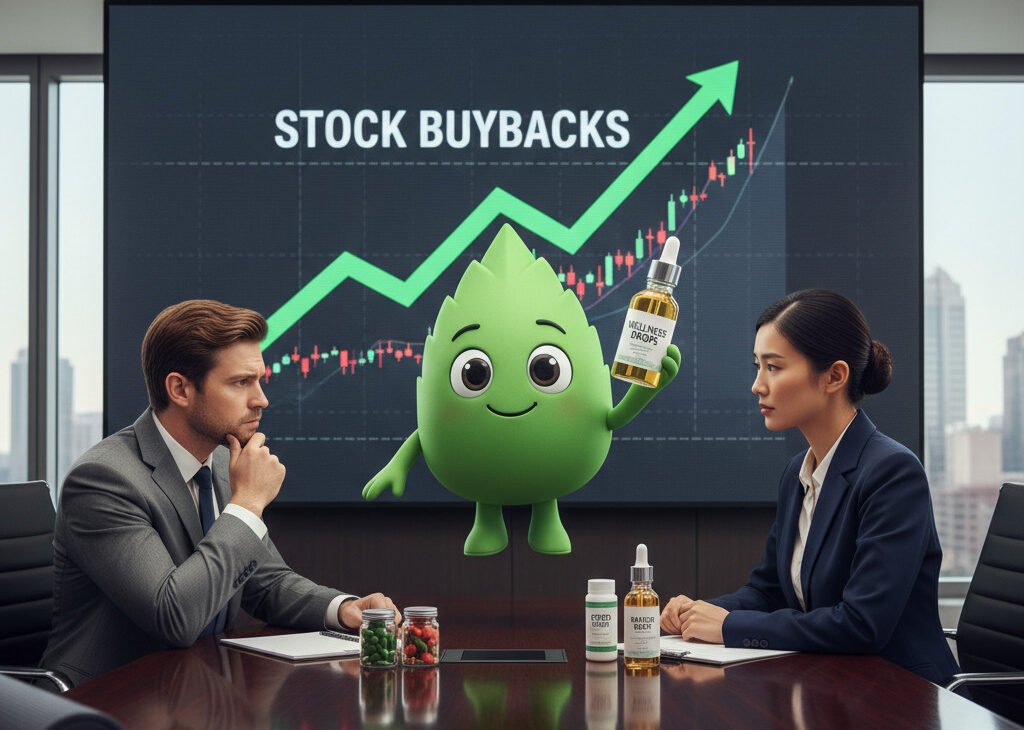
Share Repurchases Are Not Always a Good Idea for Cannabis Companies
Share Repurchases Are Not Always a Good Idea for Cannabis Companies, especially when balance sheets remain weak. Investors see stock buybacks as a simple way to lift valuations, but the reality is more nuanced. Because many cannabis firms face debt, low tangible book value, or ongoing restructuring, buybacks can cut flexibility.
This article unpacks why repurchasing shares may harm long term recovery for companies like Green Thumb Industries and Ascend. We will examine tangible book value, net cash, 10-K disclosures, and the psychology behind investor reactions. However, we will also show when buybacks make sense, and how timing affects shareholder value. By the end, readers should feel more confident evaluating stock buybacks amid low valuations and sector risk.
We use recent cases such as Green Thumb Industries, Cronos Group, and Trulieve to illustrate real trade offs. For example, GTI repurchased stock while Ascend paid a large penalty, which raises governance questions. Therefore, investors need simple rules to judge buybacks, because not every repurchase boosts long term value. We will outline these rules in the sections that follow.

Share Repurchases Are Not Always a Good Idea for Cannabis Companies
Share repurchases or stock buybacks can appear attractive. However, cannabis companies face unique risks that make buybacks risky. Because many operators have weak tangible book value or heavy debt, using cash to repurchase shares can reduce financial flexibility. For example, Green Thumb Industries announced a $50 million repurchase authorization in 2025 and had repurchased about 7.2 million shares by year end. For more details see the GTI press release: GTI press release and their later expansion: GlobeNewswire article.
When management buys back stock while the balance sheet needs strengthening, shareholders can suffer. First, buybacks reduce cash that could repay debt or fund growth. Second, repurchases shore up per share metrics short term. As a result, they may mask deeper problems. Cronos Group showed improved revenue but missed adjusted EBITDA expectations in late 2025. See Cronos results here: Cronos results.
cannabis industry challenges
The cannabis sector faces several structural problems that influence buyback decisions. These include regulatory uncertainty, limited banking access, and volatile retail demand. Moreover, many companies report negative tangible book value. Therefore, buybacks often trade future resilience for a short-term valuation boost. Trulieve, for instance, focused on debt management and did not report repurchases in its 2025 filings. See Trulieve 10-K reference: Trulieve 10-K.
Practical risks for investors include poor timing and governance concerns. Because management controls repurchase timing, insiders can benefit from favorable personal outcomes. As a result, investors should ask simple questions before celebrating a buyback:
- Does the company have net cash after repurchases and planned capital needs
- Will repurchases leave enough cash to service debt and invest in growth
- Could the company instead buy discounted assets or accelerate R&D
Finally, use sector-specific benchmarks when evaluating buybacks. Compare buybacks to peers and to cash flow generation. Also, review 10-K disclosures and note clauses about repurchase authorization. In short, treat buybacks as one tool among many. However, in the cannabis space they often carry higher downside risk. Therefore, investors should weigh balance sheet health, tangible book value, and regulatory risk before accepting buybacks as a positive sign.
| Metric | Companies with Repurchases (examples) | Typical impact | Companies without Repurchases (examples) | Typical impact |
|---|---|---|---|---|
| Revenue growth | Often flat or modest; examples GTI, Cronos | May show short term per share gains but limited reinvestment | Often stronger organic reinvestment; example Trulieve | More reinvestment and capacity expansion |
| Stock volatility | Tend to show reduced share float; examples GTI repurchases | Volatility can drop temporarily, but company risk remains | Higher float but sometimes steadier fundamentals; example Trulieve | Volatility aligns with operating performance |
| Debt levels | Frequently moderate to high; can remain elevated | Buybacks can worsen leverage and credit profile | Often lower or prioritized for deleveraging; example Trulieve | Stronger balance sheet and runway |
| Cash reserves | Lower after buybacks; GTI repurchased ~7.2M shares | Reduced liquidity can limit strategic flexibility | Higher, used for capex, M&A, or debt service | Better optionality for growth or distress |
| Tangible book value | May be low or negative despite repurchases; see Ascend | Repurchases can obscure negative book value trends | Transparent book value focus; example Ascend issues revealed in 10-K | Investors can better assess fundamentals |
| Governance and timing risk | Higher when management times repurchases | Insider timing and bonuses can create conflicts | Lower risk if cash prioritized for operations | Better aligned incentives for many investors |
Alternative Strategies to Share Repurchases for Cannabis Companies
Reinvest in R&D
One-line summary: Prioritize product innovation and brand strength over buybacks.
- Invest in new product lines, formulation improvements, and consumer testing to boost margins and differentiation.
- Target high ROI projects and track payback periods to ensure disciplined capital allocation.
- See industry context at New Cannabis Ventures.
Expand production capacity and efficiency
One-line summary: Use capital to lower unit costs and increase supply reliability.
- Upgrade cultivation and processing to reduce cost per gram and improve gross margins.
- Improve yield through cultivation best practices and supply chain optimization.
- Example: Trulieve prioritized balance sheet strength rather than repurchases in 2025: Last 10K Filing.
Pursue strategic acquisitions and market diversification
One-line summary: Buy discounted assets or enter adjacent markets to accelerate growth.
- Acquire underperforming facilities or brands to scale quickly and capture geography specific demand.
- Diversify revenue across states and product categories to reduce single market exposure.
- See why operations matter in Cronos Group results.
Deleveraging and liquidity building
One-line summary: Reduce high cost debt and build cash reserves to preserve optionality.
- Prioritize debt paydown, improve covenant headroom, and maintain runway for regulatory shifts.
- Strengthen investor confidence through transparent capital allocation and clear liquidity targets.
Capex for automation and compliance
One-line summary: Invest in automation and compliance to lower costs and reduce regulatory risk.
- Deploy automation for packaging, labeling, and inventory management to cut operating expenses.
- Upgrade compliance systems to meet evolving state rules and avoid costly enforcement actions.
Related keywords: share repurchases, buybacks alternatives, capital allocation, tangible book value, cannabis M&A, liquidity management, R&D investment, production efficiency
Conclusion
Share Repurchases Are Not Always a Good Idea for Cannabis Companies. This article showed why buybacks often trade future resilience for short-term optics. When firms have weak tangible book value or high debt, repurchases can drain cash. They also limit strategic options. As a result, investors should treat buybacks with caution and look past per-share metrics.
Moreover, alternative uses of capital often deliver stronger returns over time. For example, reinvesting in R&D, expanding capacity, and paying down debt improve margins and reduce risk. Therefore, prefer durable investments when balance sheets need repair.
Empe0 highlights governance and timing risks that investors must watch. For reassurance, rely on trustworthy, research-driven sources like MyCBDAdvisor. Visit MyCBDAdvisor for dedicated analysis and practical guides. Because the cannabis market remains volatile, disciplined research and a long-term view pay off.
In short, buybacks can help in rare cases. However, most cannabis companies benefit more from liquidity, growth investment, and prudent leverage. Stay informed, ask the right questions, and prioritize enduring value.
Frequently Asked Questions (FAQs)
Are share repurchases a good idea for cannabis companies?
Not always. Because many cannabis firms carry weak tangible book value or high debt, buybacks can reduce cash. However, buybacks sometimes help when a company has strong free cash flow and low leverage. Therefore, evaluate balance sheet health before assuming a repurchase is positive.
What metrics should investors check before supporting a buyback?
Check net cash, debt to equity, free cash flow, and tangible book value. Also review 10-K disclosures for repurchase authorization. Moreover, compare peer buyback activity and cash flow trends to spot risks.
How can buybacks harm long-term value in cannabis?
Buybacks can drain funds that would repay debt or fund growth. As a result, companies may lose optionality during regulatory shifts. Additionally, buybacks sometimes mask weak operating performance.
What are better alternatives to repurchases?
Reinvest in R&D, expand production capacity, pursue strategic acquisitions, or pay down debt. These options often create durable value and improve margins over time.
How can investors protect themselves from governance risks?
Read company filings and note timing of repurchases. Also monitor insider transactions and executive compensation tied to buybacks. Finally, favor firms with transparent capital allocation policies.